Written by Ed Craig www.weldreality.com
EMail Ed ecraig@weldreality.com
Welding
Nickel Alloys:

TIP TIG superior
nickel weld quality than traditional TIG welds
If
you want all position, defect free alloy welds at superior quality than conventional
TIG, Pulsed MIG or the flux cored process and you would like to produce all position
weld deposition rates equal to pulsed MIG and flux cored, consider the TIP TIG
process. A five minute TIP TIG demo will show any weld professional that when
welding in any weld position, thin or thick metals, any alloys and any weld, clad
or brazed application, the TIP TIG process is the world's most cost effective
process for producing defect free welds.
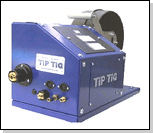
THE
NORTH AMERICAN, PATENT PENDING, ADVANCED
TIP TIG PROCESS,
IS THE WORLD'S MOST EFFECTIVE WELD, CLAD AND BRAZING PROCESS. TIP TIG IS AN EASY
PROCESS TO USE AND ALWAYS DELIVERS SUPERIOR WELD QUALITY THAN TRADITIONAL TIG
/ PLASMA WELDS. THE BONUS FOR THE WELD SHOP IS WHILE GETTING THE ULTIMATE IN TIG
WELD QUALITY, YOU ARE GETTING IT 4 TO 8 TIMES FASTER THAN A TIG WELD:
The
manual or automated semiautomatic TIP TIG process
can be used with either TIG - Plasma or a laser. TIP TIG will always result in
superior weld / clad quality and superior mechanical properties. It does not matter
what the application, the weld position, or the alloy to be welded is, TIP TIG
will deliver the ultimate attainable weld quality on all Carbon Steels, Stainless,
Aluminum, Inconel, Titanium, Hastelloy, Stellite, Duplex, Low and High Alloy Steels,
Tool Steels and Cast Steel welds and clad applications.
 The
Fossil and Nuclear industry will never attain the construction weld quality or
productivity (10 to 40 times faster than manual TIG) that the ATT manual and automated
weld process can deliver. Oil Platforms - Ship Yards - Naval Vessels and Submarines
- The Space and Aircraft Industries - Cryogenic Vessels - Petro Chemical - Refining
- Waste to Energy - Industrial Processing - Pulp and Paper - Military Equipment
- Medical Equipment - Food and Beverage, none of the North American industries
have in their weld shops a weld process that can deliver the weld quality / productivity
attainable from the easy to use, semiautomatic ATT process. The
Fossil and Nuclear industry will never attain the construction weld quality or
productivity (10 to 40 times faster than manual TIG) that the ATT manual and automated
weld process can deliver. Oil Platforms - Ship Yards - Naval Vessels and Submarines
- The Space and Aircraft Industries - Cryogenic Vessels - Petro Chemical - Refining
- Waste to Energy - Industrial Processing - Pulp and Paper - Military Equipment
- Medical Equipment - Food and Beverage, none of the North American industries
have in their weld shops a weld process that can deliver the weld quality / productivity
attainable from the easy to use, semiautomatic ATT process.
Why be concerned about the skilled welder shortage when the moderate priced TIP
TIG process is easy to use on the most difficult applications. PQR's will be easy
to produce as two simple amp / wire feed weld procedures will weld most of your
manual or automated applications. It takes about one hour to learn the one handed
TIP TIG techniques. TIP TIG will dramatically reduce your weld rework costs and
reduce your product liability concerns as it always will deliver the optimum in
weld quality. There is no weld smoke issues and no concerns for spatter. In contrast
to most other process it will provide less weld heat input. .
If highly cost effective, defect free alloy welds with superior weld appearance
are important to you. Click for TIP TIG weld information.
To watch the worlds best process weld on a pipe orbital head copy the following link and note the untouched pipe weld quality and unique multi-pass color without interpass temp control which indicates the very low weld heat.
https://youtu.be/byBer6EWy7s
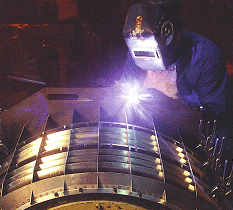
When
MIG welding nickel alloys, the welder would note many similarities to welding
carbon steels. Nickel has similar mechanical properties to carbon steels, it's
the nickel crystalline and metallurgical structure that's very different from
iron.
In contrast to carbon steels, when welding nickel, the nickel does
not undergo a crystalline / phase change up to its melt temp.To change the grain
size requires cold working and annealing. Nickel
has great solubility for elements that's why we see alloys such as Nickel - Chrome,
Nickel - Iron,
Nickel - Copper, Nickel - Moly and other commercial alloys.
In small amounts carbon, manganese, silicon, aluminum and columbian are added,
some of the these have a positive influence on the weld and some have a negative
influence.
Manganese in the range of 3 to 9 percent is added to nickel
copper alloys to improve crack resistance.
Titanium is sometimes added
to the filler metals as a deoxidizer for weld porosity reduction.
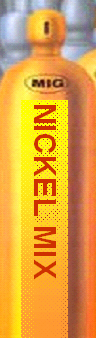 ED'S
MIG GAS FOR NICKEL ALLOYS: ED'S
MIG GAS FOR NICKEL ALLOYS:
Typically
straight argon is the gas of choice, and when more weld energy is required argon
with 40% helium have been use for MIG and pulsed MIG.
Note for those
that having been using gas mixes with Argon - < 30% helium, the weld energy
benefits will be minuscule from that helium content, and that's why the 40% helium
is recommended. Also be aware that with pulsed MIG, you can tweak the pulsed parameters
to put more weld energy in the pulsed droplets, so you won't need the helium mix.
I did this many times when establishing cladding procedures for the power and
waste management industries.
For
decades CO2 or oxygen in the MIG gas was not recommended for Nickel alloys as
these alloys are very sensitive to oxidation. In the eighties while carrying out
MIG gas research I discovered the value of a small amount of CO2 for MIG welding
nickel alloys. Visit the MIG gas section at this site for the gas data. With
MIG Nickel alloys, the addition of 0.5 to 1 percent (max) CO2 to argon not only
improves the arc stability it will also allow the
use of higher, more spray transfer wire feed rates.
INFO ON COMMON
NICKEL ALLOYS
Nickel.
Solid Solution. 200 series, typically not strengthened
by heat treat.
Nickel 200 - 201 used food and chemical processing equipment
and pipes. The 201 is used on applications over 600F. Nickel
201 99.5% nickel
-
Nickel.
Precipitation Hardenable. 300 series. Strengthened
by heat treatment.
Nickel
Copper Alloys. Solid Solution. 400 series.
High strength. High toughness and great corrosion resistance. 405 is free machining.
405 = 66.% Ni - 31% Cu - 1.25% Fe - 1% Mn.
Nickel.
Copper Precipitation Hardenable. 500 series. These
alloys (K-500) are strengthened with Al and Ti. Used when high strength / hardness
and corrosion resistance required. K500 66.5% Ni - 28% Cu - 3% Al.
Nickel
Chrome. Solid Solution. 600 series.These are the
common alloys we see in use today. 600 - 601 - 625, Good corrosion resistance
at high temperature.Good resistance to chloride-ion stress corrosion cracking
and corrosion from high purity water. Used in reactors, power plant water wall
cladding etc.Alloy 625 good MIG weldability, using pulsed or spray transfer.625
= 61% Ni - 21.5% Cr - 9% Mo - 3.65% Cb - 2.5% Fe -
Nickel
Chrome. Precipitation
Hardenable. 700 series. Strengthen by Al - Ti - Cb
additions. Common alloys 713 c - 706 - 718 - X750 - U500 - U700 - R41 - Astoloy
- Waspaloy. When Cb is used for strengthening rather than Al - Ti the weldability
is improved. Gas Turbines and Aircraft parts. X750 = 73% Ni - 15.5% Cr - 7% Fe
- 2.5% - Ti -0.95% Cb.
Nickel
Iron Chrome. Solid Solution. 800 series. Common alloys
are 800 and 825 and 20Cb. Alloy 800 is used typically in high temp applications,
has good carburization / oxidation resistance. The 825 and 20 Cb in strong corrosive
situations, good resistance to chloride-ion stress corrosion cracking and reducing
acids.825 = 42% Cr - 30% Fe - 21.5% Cr - 35 Mo - 2.5% Cu - 0.9% Ti
Nickel
Iron Chrome. Precipitation Hardenable. 900 series.
Most common 901 (Incoloy 901). Welds similar to X750, mostly used for forgings
that are not welded.901 = 42.7% Ni - 34% Fe - 13.5% Cr -6.2% Mo - 2.5% Ti.
Nickel
Moly Alloys. Known as Hastelloy B - N - W. Contains
16 - 28% Mo with some Chrome and iron. B used for hydrochloric acids. N for molten
fluoride salts, W for dissimilar metals with good corrosion and oxidation resistance.
Nickel
Chrome Moly Alloys. Known as Hastelloy. C - C276 - F - G
-X. Alloy C good corrosion and high temp properties. C-276 lower carbon
and silicon than C to reduce grain boundary precipitates enables the alloy to
be used in as weld condition.
Nickel
Silicon Alloy. Hastelloy D. This is a cast alloy
with good resistance to sulfuric acid at all temperatures.
Base
Alloy
| AWS
Filler Metals. Need more info contact Haynes Alloys. Kokomo IN.
|
Nickel
200
|
ERNi 3
| Monel
400
| ERNi
Cu 7
| Inconel
600
| ERNiCr-3
-- ERNiCrFe 6
| Inconel
718
|
718
| Inconel
X-750
| 718
|
For
dissimilar applications think about minimum weld dilution
| Short
circuit and the pulsed mode are recommended for cladding. For nickel chrome welds
on carbon steels ERNiCr-3 is a common consumable.
|
Inconel
600 - 800 to steel or stainless / monel 400.
| ERNiCr
-3 - ERNiCrFe-6
|
WELDING
TIPS, NINE PERCENT NICKEL.
CRYOGENIC APPLICATIONS.
A
common application in which austenitic stainless and 9% nickel steels is in the
construction of cryogenic, liquefied natural gas (LNG) containers. These containers
can carry liquid argon, natural gas, helium, oxygen, nitrogen etc. These liquid
gases are usually in an approximate temp range of -300 to -450F. Carbon steels
and alloy steels have poor toughness and ductility at low temperatures. The alloy
steels with nickel, austenitic steels typically 304 - 304L 316 - 316L - 347 and
aluminum alloys all have excellent low temperature toughness. Please note, TIP TIG will provide superior weld quality than traditional TIG or any MIG transfer mode.
Strict
welding regulations are applied to welding cryogenic applications. The weld metal
properties should contain low nitrogen, low ferrite, low carbon and high nickel.
Filler metals such as Nickel Chrome Molybdenum, Nickel Chrome Iron or high alloy
austenitic electrodes.
The
Nickel alloy consumables have a coefficient of thermal expansion that is close
to the 9% nickel this reduces the risk of thermal fatigue in applications subject
to thermal cycling. Typically the mechanical properties of nine percent nickel
will be higher than those of the weld consumables utilized. This requires special
consideration to weld qualification tests. Note that with the 30X in centrast
to the 30XL (low carbon grades).
The higher the carbon content the lower
the impact toughness.Shop built stainless steel cryo vessels in the USA are built
to ASME Boiler Pressure Vessel Code Section V111. Field erected vessels may use
the API 620 Q. Austenitic stainless accounts for the majority of metals used for
cryo applications. The rest of the applications use 5 to 9% nickel or aluminum.
Where high strength is required nine nickel may be chosen instead of an austenitic
steel. Its important to remember that nine percent nickel is an alloy that can
rust.
WELDING
TIPS FOR NINE PERCENT NICKEL.
The best possible weld process would TIP TIG.
Keep
the carbon in the rage <0.03%. Low carbon superior toughness.
With
SMAW, Lime electrodes provide higher low temp toughness than the titania electrodes.
Weld
Inclusions. Slag inclusion can lower low temp toughness. Keep this in mind when
comparing weld processes. The three best processes for toughness are TiP TiG - GTAW and GMAW.
As
porosity or inclusions are a result of an oxide reaction its logical when MIG
welding to use a low reactive gas mix. For stainless applications forget that argon
2% oxygen mix recommended by the gas companies, use the gas mix developed by Ed,
which is is an argon mix with 2% CO2. The argon CO2 mix is much less oxidizing and does not have
enough CO2 to add to the carbon content of the weld.
Nitrogen
pick up will increase the strength of the stainless welds however it decrease
the low temperature toughness.
If
using SAW for stainless, its difficult to meet the weld impact requirements on
applications below - 300 F, consider TiP TiG or second choice MIG.
If
the stainless pipe ID root weld finish is important, to attaini a smooth surface dont use pulsed. The best weld process for automated nickel welds would be TiP TiG.
Nine
percent nickel is often used for economic reasons for large plate, cryo pressure
vessel applications down to -320 As mentioned this metal can rust, so this alloy
cannot be used on applications where contamination is a concern.
Nine
percent nickel cryo vessels are built to ASME Boiler Pressure Vessel code SectionV111.
Two
material specs are used for the common nickel plates.
[1] ASTM SA 553/SA
553M Spec for pressure vessel plates. Alloy steels Quenched and tempered 8-9%
Nickel.
[2] ASTM
SA 353/SA-353M Spec for pressure vessel plates. Alloy Steels Doubled Normalized
and tempered.
ASTM.
AS 553 and SA 353 have the same chemistry 8.5-9.5 nickel the yield strength of
353 is 75 ksi to 85 ksi for the 553.
Most
pressure vessel plates are QT 553.
Weld
procedure qualifications for 9% nickel according to section 1X of the boiler code
requires impact test made at -320F or the lower operating temp. The impact test
covers
the weld d HAZ. Transverse tensile and bend tests are also req.
General Weld Information For Nickel Alloy Welds.
Weld
Note: Due to hardening potential and the formation of refractory oxides consideration
is required for Precipitation Hardenable nickel steels.
TiP TiG is the logical process for these alloys. The primary
weld differences between carbon steel welds and nickel alloy welds will be;
[1] The nickel welds will be much more
sluggish, weld fusion is always a primary concern. Note the high weld energy and agitated weld pool with the TIP TIG mode does not have fusion concerns with sluggish alloys.
[2]
The nickel welds are very sensitive to oxidation that can lead to extensive weld
porosity. With MIG reactive gas mixes are required. Be concerned about the quality and reactive gas composition of the MIG gas mixes available at
your local gas distributor.
Many cylinders used for argon mixes may have previously
been used for argon 20 - 25% CO2 or argon Oxy mixes. The remains of the reactive components in the cylinders could influence oxidation. If you order 99% argon 1% CO2, ensure the cylinders used have dip tubes and that a certificate of
gas composition is presented for each cylinder. Ensure you have adequate
gas pre-flow and post-flow.
Note:
With TIP TIG, you use argon so you should habe less oxidation concerns.
[3] The magentic influence
on the arc is much more noticeable with nickel alloys, again this is a good reason
to use Ed's MIG gas mix as the CO2 provides improved electron transfer and improved
arc stability.
[4] The crack sensitivity
is much greater with nickel alloy so use low to moderate weld parameters.
[5] The cleanliness in the weld areas is super
critical when welding nickel alloys. Welding and post weld heating should only
be carried out on nickel alloys that are clean and free of contaminates. Grinding
and shot blasting are effective. With grinding use wheels that are dedicated only
to the nickel welds. Wire brushing will typically not fully remove the surface
oxides. If brushes or power brushes are utilized ensure they are made of stainless
steels.
[6] Nickel alloys are sensitive to
embattlement from phosphorous, and sulfur and these elements are found in many
of the materials used in metal forming. Plasma or laser cutting oxides which will
have higher melting temperature than the base metal should be removed from nickel
alloy plate edges that will be part of the welds. The higher temp cutting oxides
can act as a barrier against the sluggish nickel welds impeading weld fusion potential.
The oxides from the cutting surfaces can also create internal weld porosity and
cause a reduction in the nickel mechanical properties.
In contrast with
carbon steels in which the oxides and inclusion typically rise at a fast pace
to the weld surface, with the sluggish composition of nickel welds, the contaminates
on the plate are more likely to become trapped in the weld. The sluggish nature
of the nickel welds can also cause extensive lack of weld fusion especially on
MIG welded parts > 4 mm. Lack of weld penetration can cause a point for stress
concentration. When welding tube or pipe or butt welds with full penetration treat
the weld like a stainless weld and ensure the backside of the root has an argon
purge.
Note:
With the higher weld - arc energy and unique weld agitation in a TIP TIG weld you will have much less internal weld defects than any other weld process.
.
[7]
Weld heat typically does not have a negative impact on the nickel alloys.
A small amount of grain growth and annealing will occur in the welds HAZ.
[8] When you do a tensile test on a nickel
welded sample, please keep in mind that the annealed part of the HAZ will be the
first location to elongate. The plastic elongation will cause strain hardening
which "actually increases the yield strength". The
bottom line is the work hardening influence on the elongation is influenced by
the size of the HAZ, and its important to remember that transverse tensile elongation
or the noted transverse yield strength attained can be misleading.
[9]
With multi-pass welds
be aware of the weld heat input build up, especially when welding those oxidation 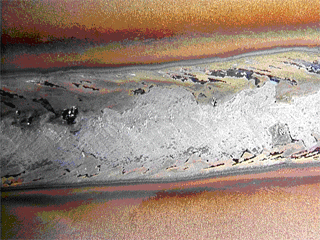 sensitive, precipitation hardenable alloys which can leave an oxide
surface on the weld that can impead multi-pass weld fusion potential. All Nickel
welds subject to excess weld heat will be influenced by atmospheric contamination
creating a severe oxide on the weld's surface. For mult-pass welds use interpass
temperature controls (typically 300 to 350F) to minimize both the heat influence
on the weld HAZ and oxidation potential. sensitive, precipitation hardenable alloys which can leave an oxide
surface on the weld that can impead multi-pass weld fusion potential. All Nickel
welds subject to excess weld heat will be influenced by atmospheric contamination
creating a severe oxide on the weld's surface. For mult-pass welds use interpass
temperature controls (typically 300 to 350F) to minimize both the heat influence
on the weld HAZ and oxidation potential.
Note: With TIP TIG the lowest weld heat should be produced with the cleanest possible welds.
[10]
Pre-heat is typically
not necessary for nickel alloys if the metals are at or above indoor shop temperature.
If the metals have been stored outside or moisture is suspect to reduce the weld
porosity potential, pre-heat the metals between 70 and 100F.
[11]
Post heat treatment
is usually not required for the common nickel alloys after welding to attain the
desired corrosion resistance. However with nickel chrome 600 alloy, stress relief
is required for fused-caustic service applications and also for alloy 400 applications
as used in hydrofluoric acid service. Also note the nickel molybdenum and nickel
silicon alloys HAZ can lower the corrosion resistance therefore these alloys may
require a postweld solution-annealing treatment to restore the corrosion resistance
of the HAZ.
Nickel
Alloys and FILLER METAL SELECTION
Filler
Metal Selection. As corrosion potential is the primary concern in the selection
of nickel alloys the filler metal should have similar chemistry composition to
the base metal to be welded. The 600 series nickel chrome and nickel- iron - chrome
alloys can end up with that austenitic problem caused by carbide precipitation
(CP) in the HAZ, see the stainless section. Its reported that the CP does in most
cases not result in accelerated corrosion attacks. Like stainless weld consumables,
additions of columbian or titanium are added to specific filler metals such as
the popular Inconel 625 are used to help stabilize the welds and minimize the
CP influence.
With
MIG welding remember you will get greater current density (less sluggish welds)
from smaller wire diameters. Welding under 6 mm thickness, I would recommend an
0.035 (1 mm) nickel MIG wire. Welding thicker than 6 mm, consider an 0.045 (1.2
mm) wire.
 DON'T FORGET ED'S
UNIQUE MIG GAS MIXES FOR NICKEL ALLOYS: DON'T FORGET ED'S
UNIQUE MIG GAS MIXES FOR NICKEL ALLOYS:
You can use straight argon for the Nickel
MIG welds, however when using MIG spray transfer consider argon with 1% CO2, for
applications 3 to 6 mm. For spray applications over 6 mm, to attain more weld
energy try a three part mix containing argon - 40% helium - 1 % CO2. Use gas flow
rates in the range of 40 to 60 cuft/hr. For those of you that are considering
pulsed rather than spray, remember nickel welds are sluggish going from a pulsed
peak to a low background weld current does not improve a sluggish weld in contrast
to traditional spray. When TIG welding use the same filler metals as MIG with
straight argon, treat the nickel welds as you would stainless welds.
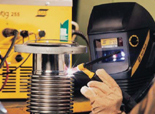 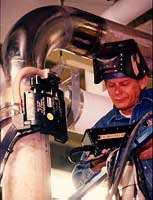
[]
When welding the 300 series of stainless to carbon steels the austenitic 309 filler
metal and sometimes 310 are utilized. The 310 25% Cr - 20% Ni, can cause the austenitic
welds to fail due to microfissuring which resulted in cracks in applications subject
to thermal stresses. The weld failures were often a result of the differences
of the coefficient of thermal expansion (CTE). The 309, 23% Cr - 13% Ni filler
metal when used on stainless to carbon steels results in a weld with ferrite reducing
the potential for mico-fissuring, however keep in mind depending on the application
chemistry, thickness, weld process and parameters used, the dissimilar weld joints
are still dilution sensitive. The 309 filler when used on stainless to steel welds
still have large CTE differences therefore one should be concerned when the welds
or parts are subject to temperatures over 600F in which high stresses or thermal
fatigue effects the ferritic / austenitic weld interface.
[]
Where the 309 and 310 have problems the weld solutions are frequently found with
the 600 series Ni Alloy filler metals.
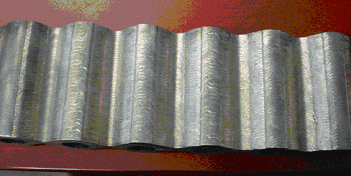
Ed
developed this Inconel 625, pulsed MIG water wall clad
procedure, patented
in 2007: Check the clad section.
[]
The 600 series as many of you know are often called Inconel. These high Ni-alloy
filler metals typically contain up to 72 nickel 15 % Chrome and 8% Fe. These filler
metals have a much lower CTE than the 300 series austenitic alloys.When welding
the lower CTE results in less weld thermal stresses. The Inconel alloys are also
less sensitive to weld microfissuring or weld dilution concerns from dissimilar
metals.
[]
When parts are in service at temperatures >700 F, welds that contain high nickel
to chrome ratios can be sensitive to sulfur corrosion. This risk is reduced with
filler metals that have higher chrome / moly. Alloys 625 / 671. The 671 is AWS
(ERNiCr-4 rod)
[]
The 625filler, EniCrMo-3 rod , MIG and flux cored wire should be restricted to
applications <1000F as weld embrittlement can occur.
[]
For a story on how not to use Inco 625 for cladding boiler water wall tubes click.
WELDING,
NINE PERCENT NICKEL
CRYOGENIC APPLICATIONS.
A
common application in which austenitic stainless and 9% nickel steels is in the
construction of cryogenic, liquefied natural gas (LNG) containers. These containers
can carry liquid argon, natural gas, helium, oxygen, nitrogen etc. These liquid
gases are usually in an approximate temp range of -300 to -450F. Carbon steels
and alloy steels have poor toughness and ductility at low temperatures. The alloy
steels with nickel, austenitic steels typically 304 - 304L 316 - 316L - 347 and
aluminum alloys all have excellent low temperature toughness.
Strict welding
regulations are applied to welding cryogenic applications. The weld metal properties
should contain low nitrogen, low ferrite, low carbon and high nickel. Filler metals
such as Nickel Chrome Molybdenum, Nickel Chrome Iron or high alloy austenitic
electrodes.The Nickel alloy consumables have a coefficient of thermal expansion
that is close to the 9% nickel this reduces the risk of thermal fatigue in applications
subject to thermal cycling. Typically the mechanical properties of nine percent
nickel will be higher than those of the weld consumables utilized. This requires
special consideration to weld qualification tests.
Note that with the
30X in centrast to the 30XL (low carbon grades). The higher the carbon the lower
the impact toughness.Shop built stainless steel cryo vessels in the USA are built
to ASME Boiler Pressure Vessel Code Section V111. Field erected vessels may use
the API 620 Q. Austenitic stainless accounts for the majority of metals used for
cryo applications. The rest of the applications use 5 to 9% nickel or aluminum.
Where high strength is required nine nickel may be chosen instead of an austenitic
steel. Its important to remember that nine percent nickel is an alloy that can
rust.
PLEASE REMEMBER
THE FIRST CONSIDERATION WITH WELDING COMPLEX ALLOYS IS THE WELD PROCESS: No other manual or automated weld / cladd process can produce the weld quality on nickel alloys that is attainind with the TIP TIG process can be used with
either TIG -
| |