This report reveals how the progressive management at Freight Liner
provided their employees with my weld process controls & best practices.
The
following robot changes have been implemented at your facility. The changes were made in the
existing weld programs of the ABB 2400 series robots. The robot program changes completed
in the first week of Aug, were designed to improve the weld fusion potential, reduce the porosity and
also to reduce the weld cycle times of both your HD and LD parts. My new weld programs
were put on discs and delivered to the engineering personnel.
The following
welding recommendations improved both the weld quality and productivity.
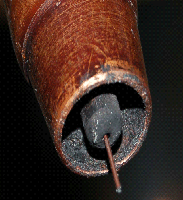 *
MIG GUNS AND CONTACT TIP POSITIONS: The benefits of recessing the robot contact
tips
*
MIG GUNS AND CONTACT TIP POSITIONS: The benefits of recessing the robot contact
tips
3 mm inside the nozzle were proven with the robot test welds made. The recessed
tip greatly extends the tip life, reducing wire burn back potential and robot
downtime. The recessed contact tip provides a lightly extended wire extension
which lowered the weld current . The reduction in current enabled me to increase
the wire feed rate increasing the weld travel rate and decreasing
the weld time.
Instead of purchasing new
tips or longer nozzles I had 3 mm spacer O ring sleeves machined, which when placed
behind the nozzle provided the correct tip position.
*
MIG GAS MIXES AND WELD FUSION: The argon 2% oxygen mix used at Gastonia is a low energy oxidizing mix. To enhance the opportunity for superior weld fusion with my higher
speed welds, I used an argon + 15 CO2 mix.This gas mix provided improved weld
fusion profiles in all the weld tests we carried out and as this mix provided
higher weld voltage, the arc stability was improved.
 As
each robot will utilize the equivalent of a gas cylinder per shift per week, I
would recommend that at this time you do not make changes to a bulk system and
go with cylinders for the present. There appears to be restrictions to the gas
flow in the 2400 cells, the gas flow rate was reduced by fifty percent from the
flowmeter to the gun nozzle outlet. It should be part of the robot operators daily function
to ensure that 35 to 40 cuft/hr is available at the gun nozzle exit. The restricted
gas flow will effect a weld penetration profile and increase the weld porosity
potential.
As
each robot will utilize the equivalent of a gas cylinder per shift per week, I
would recommend that at this time you do not make changes to a bulk system and
go with cylinders for the present. There appears to be restrictions to the gas
flow in the 2400 cells, the gas flow rate was reduced by fifty percent from the
flowmeter to the gun nozzle outlet. It should be part of the robot operators daily function
to ensure that 35 to 40 cuft/hr is available at the gun nozzle exit. The restricted
gas flow will effect a weld penetration profile and increase the weld porosity
potential.
* THE WELD POROSITY ISSUES: The weld porosity in the welds
was influenced primarily by the lubricants left on the welded part surface, the anti-spatter system which put too much lubricant in the nozzles and the argon oxygen mix. Operators do clean the parts, however more emphasis
could be placed in improvements in this area.
*
AUTOMATED ANTI SPATTER ROBOT SPRAY SYSTEM: This equipment in the robot cell should
be checked by maintenance weekly especially when one considers the importance
of the high weld quality required and the influence of anti-spatter lubricant on the weld quality. On my initial visit the anti-spatter system was set too high in one cell, resulting
in excess anti spatter compound being ejected from the nozzle on the weld part surface. Anti spatter compounds will add to the weld porosity and weld cracking potential.
Your operators
should not be allowed to set the anti-spatter unit which has now been reset to a much lower amount. The anti spatter
liquid should deliver a minuscule amount of compound after each nozzle clean cycle.
The small amount of anti spatter compound does assist in the easy removal of the
spatter in the nozzle ream cycle. The new welding program I produced provides much less spatter and therfore we reduced the nozzle
cleaning requirements which enabled less anti spatter compound is used.
 * THE
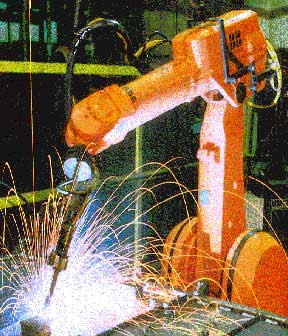
ROBOT WELD CYCLE TIMES: As you are aware I have decreased the robot weld cycle time by
2 minutes per part resulting in a saving of over 3300 hrs robot weld time per
/100.000 parts for this one application. The same savings will also be generated
on the LD parts. The weld time reduction is primary a result of changing the weld
sequence, improving the deposition rates, improving the efficiency of the robot
manipulations, removing the nozzle cleaning from every part and programming the
cleaning action to occur for only one in five parts.
* THE
ROBOT WELD CYCLE TIMES: As you are aware I have decreased the robot weld cycle time by
2 minutes per part resulting in a saving of over 3300 hrs robot weld time per
/100.000 parts for this one application. The same savings will also be generated
on the LD parts. The weld time reduction is primary a result of changing the weld
sequence, improving the deposition rates, improving the efficiency of the robot
manipulations, removing the nozzle cleaning from every part and programming the
cleaning action to occur for only one in five parts.
*THE ROBOT WELD DATA: My objective with your welding application and the robot weld decision makers was to provide as much data
as possible to enable optimum, consistent weld fusision from process controls. Consistent weld quality from
each shift is only achieved when all those involved in the robot application are
aware of the variables that effect consistent weld fusion. As you are aware attaining
consistent weld FUSION for this critical high milage warranty application is a sensitive issue, and
any changes outside my recommendations will effect that weld fusion. The same
process control - best practices logic also applies to attaining consistent weld productivity from
each shift. It would be beneficial for weld process control data I provided if
the data was placed on a poster size board outside each of the robot cells involved
with this application.
Please note that the most critical
locations on your welds are the first and last 30mm of weld. It will be notable
that when you cut and etch your weld samples you may note that one side of the
weld indicates superior fusion than the other side, this results from the tendency
of MIG towards lack of weld fusion on cold starts. Lack of weld fusion is also
common at the completion of the weld at the weld tie in. I recommend that the weld speed be slowed down by 10% in the next table for these two
critical areas. Please ensure this data is reviewed and understood by the operators.
* THE ROBOT MIG WIRE: As each
drum of wire is replaced, the operator should examine the cast and helix as the
wire is cold fed from the gun, and if required adjustments should be made to the
wire straightner if necessary. Please note I recommend you change from te E70S-6 wire you are using to a E70S-3
wire which will produce slightly less surface slag islands and reduce undercut potential.
* THE LACK OF A ROBOT CELL LOG :If wire problems, equipment problems, part
and fixture or weld problems, occur during the shift there is no documentation being produced. Ensure that each operator document all problems in the robot
cell log. These logs should be reviewed by the weld team at least once a week.
*
ROBOT TRAINING: Your ABB 2400 series robots, with the S4 control, provides your organization
with the ability to utilize unique tools which will have significant practical
weld benefits. As you are aware few of your programmers or operators are proficient
in the ABB programming and when training is provided much of it will be quickly
forgotten when an operator does little more than operate the existing programming. These factors unfortunately add greatly
to the underutilization of the robots at your facility and also add extensive
time required for the programming when a prototype part is presented.
I would recommend the selection
of your most experienced operator and make him your robot technician. Send this
person for training at the ABB robot school till he feels fully confident in his programming
ability.
* ROBOT PROCESS CONTROL - BEST PRACTICES TRAINING: The most important step in maintaining
consistent robot weld quality and productivity is to train the operators with my unique, weld
process control training program. It's extremely important that the robot operators be
aware of what they can change and what they must not touch. It's also important
that these individuals have the ability to recognize the arc sounds, as this is
an excellent diagnostic tool for a robot cell. At the start of the shift and after lunch the first parts welded by the robots should be carefully examined before production fully starts.
I wish to thank your management and engineers for their full cooperation
and look forward to working with your organization in the future.
Sincerely. Ed Craig.
Back to Robot Management 2