 |

|
Welcome to the world's largest web site on MIG , Flux Cored and TIG. Weld Process Controls & Best Weld Practices. To get to the root cause of GMAW (MIG) & Flux Cored (FCAW) weld issues, requires Weld Process Controls and Best Weld Practice expertise. This part of the program deals with MIG and flux Cored weld costs.
This web site was first established in 1997 by Ed Craig. Contact Ed now Em Craig. ecraig@weldreality.com
WELCOME TO E CRAIG'S SIMPLIFICATION OF MIG & FLUX CORED WELD COSTS.
|

|
|

|
WHAT DO SHIP YARDS AND CAR PLANTS OFTEN HAVE IN COMMON? THE BAD NEWS: THE GOOD NEWS:
|

WELDING COSTS AND SHIP YARDS.
FOR DECADES, IN MANY (NOT ALL) SHIP YARDS, THE WELD REWORK DOLLAR COST PER-SHIP, IS TYPICALLY MEASURED IN THE MILLIONS AND SOMETIMES IN NAVY YARDS HUNDREDS OF MILLIONS OF DOKKARS, THE REALITY IS FEW SHIP YARDS HAVE THE EXPERTISE TO ESTABLISH BEST MIG / FLUX CORED WELD PROCESS CONTROLS AND BEST WELD PRACTICES, AND FRONT OFFICE AND SHOP FLOOR WELD PROCESS OWNERSHIP IS SADLY LACKING.
WHEN MANAGERS HAVE WELD PROCESS CONTROLS & BEST WELD PRACTICE EXPERTISE, IT'S EASY TO GENERATE MULTI-MILLION DOLLAR COST SAVINGS PER-SHIP:
During the first four months of 2007, I presented my unique, manual, gas shielded flux cored process control training programs to Aker Kvaerner. Aker is an international ship builder and this ship building yard was located in the Philadelphia Naval Ship Yard.
The 300 plus welders in the yard mostly used E71T-1 (1.2 mm) flux cored wires to weld all position, vee groove, 12 to 25mm, steel joints with ceramic backing.
Like many ship yards, the Aker training department weld focus was on SMAW welder "skills and the German engineers and managers at this yard loved to talk about the SMAW process". To work at the yard, the welders had to pass an all position, gas shielded flux cored weld qualification test. The welds were in accordance with the ABS welder qualification requirements and with the information from the yard's weld procedures.
IT'S BEEN MY EXPERIENCE AT THE NORTH AMERICAN SHIP YARDS THAT I WHEN MANAGERS HAVE PROCESS CONTROL - BEST PRACTICE EXPERTISE,IT'S EASY TO GENERATE MULTI-MILLION DOLLAR COST SAVINGS PER-SHIP:
During the first four months of 2007, I presented my unique, manual, gas shielded flux cored process control training programs to Aker Kvaerner. Aker is an international ship builder and this ship building yard was located in the Philadelphia Naval Ship Yard.
The 300 plus welders in the yard mostly used E71T-1 (1.2 mm) flux cored wires to weld all position, vee groove, 12 to 25mm, steel joints with ceramic backing.
Like many ship yards, the Aker training department weld focus was on SMAW welder "skills and the German engineers and managers at this yard loved to talk about the SMAW process". To work at the yard, the welders had to pass an all position, gas shielded flux cored weld qualification test. The welds were in accordance with the ABS welder qualification requirements and with the information from the yard's weld procedures.
IT'S BEEN MY EXPERIENCE AT THE NORTH AMERICAN SHIP YARDS THAT I WAS INVOLVED WITH, TO FIND EXTENSIVE EXPERTISE WITH THE SMAW (STICK) PROCESS, WHILE MIG AND FLUX CORED WELD PROCESS CONTROL AND BEST WELD PRACTICE EXPERTISE WAS USUALLY IN SHORT SUPPLY WITH THE PERSONNEL THAT WERE RESPONSIBLE FOR THE WELDS.
The ABS flux cored welder qualification test was nothing more than a chance for the welders to put numerous weld that meant little into a groove joint, and then spend extensive grinding the welds. The ABS welder qualification test also had little in common with the weld requirements and weld application variables which are typically found in any ship yard.
To show the management what an important missing link was in their yard, I provided a fundamental written process control weld test for all those involved including supervisors and QA personnel. The process test revealed that all those who had passed the welder qualification test had a good reason why most of the weld personnel "played around with their weld controls" One hundred percent of the employees including the engineers lacked flux cored weld process control - best practice expertise, and lacked the awareness of the unique requirements necessary to consistently achieve optimum weld quality for the Vee Groove, ceramic backed plate welds. I believe the same results would be attained in any global ship yard and especially in Naval ship yards. Flux Cored Process Controls - Best Practice TRAINING:
|
In a time of global, MIG - flux cored and TIG welder shortage, when many companies find it difficult to interrupt their daily fire quenching efforts in the weld department, management take note. Ed's unique weld process training program typically only requires 8 - 12 hours, with 50% classroom time and 50% hands on and the results will be instant.
At the Aker yard the management was enthusiastic about the new flux cored training program. It took a few weeks to train the 300 plus yard welders. Immediately at the training completion, the Aker ship yard QA department management and personnel started to analyze the weld rework results and costs.
I have never understood the typical QA department weld inspection philosophy that's prevalent in most global weld shops. These shops freely have large budgets for the QA department personnel who's goal in life is to FIND WELD DEFECTS, AFTER THE WELDS ARE COMPLETE. From my perspective it would make much more sense if QA personnel were trained with the process control - best practice requirements that COULD PREVENT THE DEFECTS.
Three months after Ed's flux cored weld process control the training, the ship yard NDT results indicated a 50 - 60 % reduction in the required weld rework per-ship. The ship yard management reported that the reduced weld rework, labor and NDT costs, would resulted in a cost savings of approx. 4 - 5 million dollars per-ship.
THE WELD COST BENEFITS FROM THE ONE DAY BEST PRACTICES - PROCESS CONTROL TRAINING PROGRAM:
Examine the real world ship yard weld cost reduction and benefits from my unique flux cored process control training program. The training program required 300 x 8 man/hr. = 2400 man hours at an approx. $30/hr, base labor cost for the ship yard. $72,000. For the training. To this add the actual training costs of approx. $100,000 = for a total training costs for the 300 welders. Total Train cost, 2400 man/hrs for an approx. cost of $172,000.00.
With a $172K invested the ship yard initially saved approx. four - five million dollars per-ship. Also an unreported fact from this yard was the qualified changes that I made also dramatically increased the flux cored wire feed rates, (weld deposition rates), increasing the yard daily weld productivity in the range from 20 to 40%.
Some of you may wonder what's the difference between this type of weld training program and the MIG and flux cored weld training you could expect in any North American, Korean, Chinese, Japanese, European ship yard or any manufacturing facility?
For decades conventional training in ship yards, Navy yards and manufacturing plants has focussed on the "welders skills", especially on stick welding skills which has nothing in common with the requirements for MIG or flux cored weld.
It's not unusual for weld personnel to have weeks of hands on MIG and flux cored welder training at the ship yards and then find that when it comes to MIG and flux cored welds, the welders will;
[a] Play with the MIG weld equipment controls and rarely dial in optimum settings for the different welds.
[b] Utilize the weld controls in a very limited manner. In the ship yards I visited it was common to find the welders would all use one setting for all welds. (its enough to make a grown man cry).
[c] Not utilize the optimum best practices - weld techniques necessary for the MIG and flux cored process. Typically inappropriate stick weld techniques were common with the MIG and flux cored process.
[d] Lack awareness of the weld deposition rate potential for a specific weld and the parameters selected. This of course limits the daily weld productivity potential the welders could achieve.
The Flux cored and MIG process control training that I provide, is available on line and in a CD power point format. As with all my training programs, the training enables each individual to achieve weld process optimization for the flux cored consumables utilized and for the all position, vee groove, ceramic backed, or open root applications.
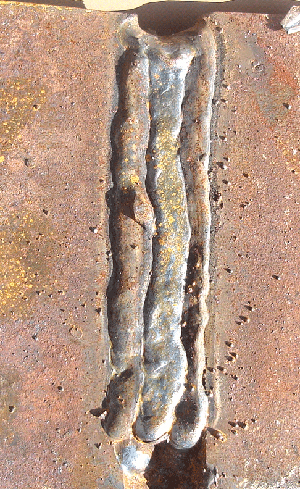
For the welders who took the eight 8 hour training, program the simple clock method enabled those individuals to have the ability to instantly set optimum parameters for both the consumables and the weld joint variables which in the yard were many. This training provides instant dramatic improvements in their weld ability as you can see with this before and after weld.
As you can see, on the left picture we have a weld made by a so called qualified ship yard welder that obviously had poor weld skills, poor techniques and used poor settings. These two vertical up, 15 mm vee groove, ceramic backed weld samples, using E71T-1 flux cored wires and straight CO2, were made by the same welder on the day of training. On the left, before the training, and on the right after the 8 hours of my best practice - process control training.
Even when the welder had good skills, this process control training will increase the welders weld quality and productivity capability. What was also important, each welder became aware of the unique flux cored weld parameters and technique requirements to address the variable edge preps and root gaps over the ceramic. Ceramic is rarely used outside ship yards and welding oversized root gaps across a none conductive ceramic requires unique process and technique requirements. The weld training results were dramatic, with all weld personnel attaining an instant reduction in lack of weld fusion, slag entrapment and porosity defects.
This shipyard training COSTS $172.000, versus a typical $500,000 to a million that a ship yard would readily pay.
The improvements by all the welders was immediately noticed by the ship yard QA management who daily measured the dramatic improvements evident with NDT and radiographs and the allocated man hours required for weld rework .
By the way, few global ship yards or manufacturing facilities examine the cost effectiveness of the training programs they use or develop. Instead of an eight hour training program, many yards would not think twice about providing a forty hour welder training program. For 300 welders in a North American facility, that 40 hours training with labor and associated training costs would be approx. $500,000. Plus the facility will have lost 12000 production hours.
Many thanks to some Tom O'Malley the owner of Excell. Tom's company was the prime weld products supplier to the Philadelphia Naval Ship yard. Tom provided the facilities and equipment for the training. Tom also assisted with the program in both the classroom and hands on training. Tom was one of those rare owners of a weld supply company that actually spends many hours per-week evaluating weld processes equipment and consumables.
|

Dont ask the engineering mgr. or robot tec. the cost of a ROBOT WELD.
ASK A WELD SHOP SUPERVISOR THE COST OF A MIG WELD AND THEY WILL When a manufacturing company invests in costly robots and fixtures, the robot purchase is in most instances intended to reduce the costs of manual weld production. The sad reality with many companies, is their robots rarely provide their real weld their production potential and too many robot welds require extensive manual weld repairs.The prime factors that control the robot weld production efficiency potential are;
[1] optimizing the robot wire feed rates utilized,
[2] controlling the part fit,
[3] controlling the weld size and length,
[4] optimizing the robot movement / motion times,
[5] maintaining the robot arc on times,
[6] eliminating the causes of the robot down time,
[7] eliminating the robot weld rework.
The primary influence on robot weld efficiency is the required robot �arc on time� a time regulated by the wire feed rate attained. The wire feed rate controls the robot weld speed.
WITH A PROCESS IN WHICH THE ONLY CONSTANT IS THE WIRE FEED RATE, it's unfortunate that some Japanese robot programs provide "amps" but do not provide the robot wire feed rates used. I have been in many Panasonic robot weld cells and the companies who purchased these robots do not have a clue as to the weld wire feed rates being utilized, which is not a surprise with management that rarely understands how to optimize robot MIG weld productivity.
To control MIG weld costs, someone in the plant has to understand the relationship between the desired welds, the weld wire size, the wire feed rates, the weld deposition potential and the weld deposition rates being attained. This process subject is part of the fundamental weld process expertise that should be common knowledge in all plants that MIG and flux cored weld.
FEW WILL BE ABLE TO TELL YOU THE COST OF A 1/4 FILLET WELD THREE FEET IN LENGTH, BUT MANY IN THE FRONT ODDICE WILL TELL YOU THE COST OF THEIR WELD WIRES OR GAS MIXES.
Weld process control and consumable knowledge is the key component to implementing effective BEST WELD PRACTICES - WELD PROCESS CONTROLS. This sounds logical, yet few managers and engineers have this expertise. If a manufacturing facility if the key management don't know what it takes for process optimization they will not demand it from the people who should be responsible.
To effectively manage a weld shop and maximize the daily robot weld quality and productivity, management, supervisors and engineers must provide their employees with a weld process control training program that provides;
[a] MAXIMUM WELD PRODUCTIVITY POTENTIAL WITH LOWEST WELD COSTS: To minimize weld costs, those that make the weld decisions must understand the weld process fundamentals that focus on the application's weld deposition rate potential for the part thickness, the weld size, the wire size and weld transfer mode utilized.
[b] OPTIMUM WELD QUALITY POTENTIAL: To consistently optimize weld quality, the weld decision maker must without getting advice from a salesman, fully understand the process, the weld mode, parameters, techniques and consumable requirements necessary. .
[C] WELD PROCESS CONTROLS: Once any production weld is established, that weld needs to be managed through the implementation of weld process controls. If you work in a weld shop in which weld personnel "play around" with their weld controls, how can you considers your organization to be professional when the welds are being produced by
semi-skilled personnel. You know what the welders need, provide it.
IF THE PRIME WELD DECISION MAKERS ARE NOT FULLY CONTROLLING THEIR WELD QUALITY PRODUCTIVITY AND COST, WHAT IS THE PURPOSE OF THAT WELD MANAGER, ENGINEER, TECHNICIAN OR SUPERVISOR?
This week in the global weld industry, its unlikely you will find one manager in a hundred who takes the time to have a discussion with their employees on the subject of controlling the weld department costs and providing the means to consistently provide the best possible weld quality - productivity..
The weld reality is the weld industry is too many weld supervisors are more interested in ensuring the weld personnel
are not hiding in the wash room, than in the requirements necessary to minimize their weld rework or maximize their
average daily weld deposition rates.While weld cost focus is often on the carbon steel weld consumable used, it's important to remember that the MIG / flux cored wire and gas costs will typically account for only 12 to 18% of the total hourly weld costs.
|

He is a robot weld technician at a car plant, so it looks like we will have to cut out his "play around organ"
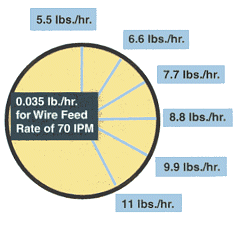
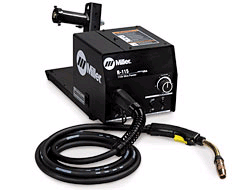
The first step in controlling MIG weld costs is understand the MIG "Wire Feed Control".
USING MY UNIQUE, SIMPLE WELD CLOCK CONTROL METHOD, WELD PROCESS CONTROLS IS MADE EASY. WITH A TRADITIONAL "NONE DIGITAL" WIRE FEED CONTROL SIMPLY DIVIDE THE WF CONTROL INTO TEN CLOCK SETTINGS BETWEEN 7 AND 5 O'CLOCK.
With my MIG and Flux Cored Weld Clock Method, each clock wire feed turn delivers approx. 70 to 80 inch./min per-wire feed control turn. In North America I use 70 inch/min per turn, and in Europe I use two meters per MIG or flux cored wire feed control turn.
WITH AN 0.035 (1mm) STEEL OR STAINLESS WIRE, EACH WIRE FEED TURN WILL DELIVER 1.1 (1 lb) POUND PER TURN: SET THE WIRE FEED CONTROL AT THE 3 O'CLOCK POSITION, THATS EIGHT TURNS (8 x70 = 560 inch/min) AND THAT WIRE FEEDER IS DELIVERING 8 - 9 LBS/HR.
ED CRAIG'S WELD CLOCK METHOD AND 0.045 (1.2 mm) WIRE:
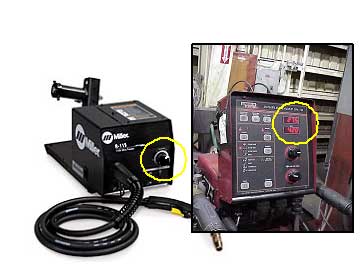
With the 0.045 wire, each wire feed turn delivers approx. 2 lb/hr. With a standard, �none digital� wire feeder, as shown on the left, to set a low Spray Transfer setting, you would set the wire feed control at the 12 o'clock position. 12 o'clock. The 12 o'clock setting is the fifth turn.
This wire feed delivers approx 700 inch/min. The fifth turn = 5 x 70 = 350 inch/min).The 12 o'clock wire feed position with the 0.045 (1.2 mm) wire would deliver approx. 10 lbs/hr. As the manual welder has an arc on time of 20 minutes per-hr he is providing 3 lb/hr. (24 - 26 pounds per-8 hour shift).
In contrast to the manual welder, the robot is also set at with the 0.045 wire feed set at 350 inch/min. The robot has an arc on time of 30 minutes per/hr, so the robot is depositing 5 lbs/hour, or 40 lb of wire per-eight hour shift. Lets say the weld supervisor was aware that this robot application could be welded with "another turn of that wire feed control" that enables 12 lb/hr, (30 min arc on time = 6 lb/hr). The robot weld production could be increased by 20% and note its 50% more weld an hr than the manual welder. Are you getting the importance of "Wire Feed Awareness" and how the Weld Clock Method simplifies process controls.
All weld decision makers should be aware of what wire feed settings can be used in the weld transfer mode selected and with the part thickness welded. Check out my unique, simple weld clock process control methods. I spent 30 years on simplifying the MIG - flux cored process CONTROLS, and most of you know how important the KIS principle is to any weld shop.
ROBOTS AND MANUAL WELD QUALITY:
The number one controlling factor of setting optimum (consistent weld fusion) quality MIG welds for any weld weld transfer mode is to select the correct size weld wire (as discussed in my training resources and understand where you set the MIG wire feed setting.
ROBOTS AND AND WELD COSTS:
The number one method of controlling MIG and flux cored weld costs is understanding the relationship between Wire Feed settings and the Weld Deposition rates attained.The majority of welds produced daily in the industrial world are based on three simple fillet weld sizes. 3/16 - 1/4 - 5/16 (4 - 6 - 8 mm). Is it therefore reasonable to expect that all the weld personnel at your company should be aware of the optimum wire feed settings and weld deposition rate potential for these weld sizes? You know where to find this training resource.
|
IT'S IMPOSSIBLE TO OPTIMIZE THE LOWEST WELD COSTS,
WHEN
THE PROCESS IS NOT OPTIMIZED?
THE MOST COMMON GLOBAL MIG WELD IS A 1/4, (6 mm) FILLET WELD.
For six decades, on conventional MIG wire feeders, the majority of manual welders when finding a setting they like, will typically place a scratch or pen mark on the Wire Feed Control.
When using an 0.045 (1.2mm) MIG wire and welding a common 1/4 (6.4mm) fillet weld, after playing with the WF controls, the welder would often place that pen mark around the one o'clock position. In an other area of the shop, again after again playing around with the WF control, the new digital wire feeders (ABOVE) were again set at 420 inch/min, (10.5 m/min). Meanwhile, over in the robot cell, that 1/4 fillet weld data is also set at 420 inch /min.
You could ask three of the most experienced weld personnel in your organization, what weld deposition rate per/hr is achieved with the wire feeds set at 420 inch/min, and also would we be better off using an 0.052 (1.4 mm) wire set at 350 inch/min? Don't bother e-mailing me their confused replies.
Now ask yourself, when are you going to get serious about being in the welding business? When are you going to get a grip of weld costs? When are you going to frown at people who have to play around with weld controls. When are you going to arrange weld process control training for all the employees involved with weld decisions?
EXAMPLE OF SIMPLE APPROACH TO MIG WELD COSTS:
THE WELD DEPOSITION. In the following example we are MIG welding 24 parts an hour. The parts are made out of 1/4 (6 mm) carbon steel. We learn from the clock method that the average weld deposition rate attained by the welder using Spray Transfer and 0.045 (1.2mm) wire set around 12 0'clock or 360 inch/min, is approx. 9 lb/hr (4.5kg/hr). If the manual MIG welders arc on time per-hour is 20 minutes, the welders will on avDEPOSerage deposit approx. 3 lb/hr or 0.125 lbs/per part
THE MIG WELD WIRE COST. This carbon steel E70S-6 MIG wire cost $1 per- lb. At 3 lb/hr, the hourly MIG wire costs $3/hour. Weld wire cost per-part is 12.5 cents.
THE MIG WELD GAS COSTS: The 80% argon - 20% CO2 cylinder mix cost $40.00 per-cylinder. A typical full size gas cylinder will deliver on average approximately 300 cuft. The cylinder gas cost is 13 cents per-cubic foot. The MIG gas flow rate per-hour is 30 cuft/hr. The welder average an arc on time of 20 minutes per hour results in a gas use of 10 cuft/hr. 10 cuft x 13 cents = MIG gas cost of $1.30 an hour, or gas cost per part is approx. 5 cents.
THE MANUAL MIG WELD LABOR COSTS: The average, 2015 hourly "welder's wage" in the USA is a sad $13 an hour, with benefits the hourly average wage would be approx. $$20 an hour. Note; some companies when trying to evaluate welding costs, like to add the total white collar overhead including the kitchen sink and the coffee machines on the backs of the blue collar labor costs. In weld cost calculations this overhead is an unnecessary distraction to the real world weld cost formula.With an overhead of $20 / hr, plus $3 / hr for wire and $1.30 hr for weld gas, the total hourly cost per MIG welder is $24 hour. Producing 24 parts an hour, the weld cost per part is a $1.
The 25% an hour increase in weld deposition allows 25% more parts per-hour. Weld productivity increases from 24 to 30 parts. With the 12 lb/hr deposition, the 20-minute arc on time results in a weld deposition rate of 4 lb/hr (1.8 kg/hr). The overhead costs are increased by a dollar for the extra one pound of wire utilized. Labor, weld wire and gas therefore cost $25 Divide the $25 by 30 parts and you have approximately $0.83 per - part for a saving of 17 cents (17 %) per-part, all from MIG weld process (deposition) awareness, and simple single turn of the wire feed control knob.
A simple turn of the MIG wire feed control, a change in wire diameter or a change from the short circuit mode to globular, or a change from globular to the spray mode, or from pulsed MIG to Spray, and most weld shops, can typically reduce their weld costs in the range of 20 to 50%.
When weld management and supervision focus on weld process capability, wire feed rates and weld deposition rate potential, this will typically ensure dramatic weld cost reduction, however this is not likely to happen with any weld shop that allows "play around" MIG / Flux cored control employees.
To make weld process changes, requires weld personnel have process confidence. This is one good reason to think a little less about spending thousands on over priced pulsed MIG welding equipment and a little more about investing a few hundred dollars for providing Ed's MIG process- Control - Best Practice programs.
Quoting the manual MIG welding trailer costs can be simple.
Using my manual or robot MIG weld process control training resources, this is how you would take my 6 simple steps approach to this task.
Five hundred trailers were required by the Smith Corporation.
Each trailer required a total of forty feet (12 m) of 1/4 (6mm) fillet weld. The 0.045 MIG weld wire used was an E70S-3. Ed's argon - 15% CO2 mix was used provided in cylinders.Franks Weld Shop was the company that got the contract to build the trailers. Frank employed five MIG welders who typically worked 8-hour days. The welder labor and benefit costs at Franks was $25 an hour. How long will it take to complete the job and what will be the welding cost?
The 1/4 (6mm) fillet weld requires approx. 0.1 lbs of weld per foot of weld. That's 0.1 x 40 feet or 4.4 lbs of filler metal required per trailer. Five hundred trailers requires = 2.200 pounds add 5% for waste. I would order 2310 pounds of MIG wire for the trailer project.
How much will the weld wire cost? The 0.045 filler metal cost $0.90 cents / lb x 4.4 lbs/part = $3.96 weld wire costs per trailer. The wire cost for 500 trailers is 2310 pounds x $0.90 = $2079.
Using my simple weld clock parameter control method, the weld decision maker would be aware of where the welders should set the 0.045 wire feed rate to weld the 1/4 (6 mm) fillets, and also that the weld deposition rate would be approx. 11- 12 lb/hr. With the average manual arc on time per/hr at 20 minutes. The welders would be depositing approx. 4 pounds per/hr. The 500 trailers will use approx 2200 pounds, divide by the 4 lb/hr, therefore the welding on the 500 trailers requires 550 man hours.
The cylinders of argon - CO2 costs $40 cyl. The cyl contains 330 cuft ($0.12 per cu/ft). The gas flow is 30 cuft/hr with the welders arc on time is 20 min. The MIG gas used is only 10 cuft/hr x 0.12 cents = $1.20 / hr for the gas. The job requires 550 hrs x $1.20 = $660 for the gas, (550 hrs x 10 cuft = 5500 cuft, divide by a cyl 330 cuft = 17-18 cylinders required for the project.
[4] The total weld consumables costs per trailer.
The cost of Wire and Gas for the job. The weld wire cost is $2079, + the Gas costs $660 = $2739. Divide by the 500 trailers and the consumable costs per-trailer is $5.48.[5] The total weld only costs per / trailer. The cost of labor is 550 man hours x $25hr = $13,750.00 for the 500 trailers. The welder labor cost per trailer is $27.50.
The total weld cost per trailer is $5.48 for the consumables + $27.50 for labor =total weld cost is $33 per trailer.
[6] The time required to weld all the parts.
The time required to do the job with the 5 welders (40 hour / day). The job requires 550 man/hours divide by 40 requires 14 days.
The bottom line is this weld cost approach is simple. In contrast, the last time I sat down with Lincoln or was it that Hobart rep? I asked for a manual weld cost analysis, these guys used a computer and delivered pages and pages of confusing weld cost data. Now I have finally got down to figuring out the real costs of the manual MIG welds, I will see if we can do anything about creating weld cost reductions with the use of my robot.
For those individuals making "weld cost decisions" or "weld process control" decisions. consider Ed's process control programs for either MIG flux cored, TIG or TIP TIG.
Ed optimized Robot MIG welds on all these applications and numerous more. In most instance those responsible for the welds at the plants, did not have a clue or show an interset in what he was doing.
SIMPLIFY ROBOT WELD COSTS. LETS WORK OUT THE ABOVE TRAILER COSTS WITH WELDS MADE BY A ROBOT.

Quoting the trailer welding costs when made by a ROBOT can be simple.We will now quote the trailer welds using a robot. Each of the 500 trailers has forty feet (12 m) of 1/4 (6mm) fillet weld. We are welding with an 0.045 (1.2 mm) MIG wire, and an argon - 15% CO2 cylinder mix.
We will use one robot with two operators. One robot operator works days, the other is on the afternoon shift. The weld labor overhead is $25/hr. How long will it take to complete the job with robot? What's the weld cost per-part? How will the cost compare to the above manual welding operation?
[1] How much weld wire required? A 1/4 (6mm) fillet requires approx. 0.11 lbs per foot of weld x 40 feet = 4.4 lbs of filler metal required per part x 500 = 2.200 lbs of MIG wire required.
[2] How much will the weld wire cost? The 0.045 filler metal cost $0.90 cents/lb x 4.4 lbs/part = $3.96 per part, or the MIG wire cost for 500 parts is $1980.00.
[3] How many robot / man hours required? Using my Weld Clock Parameter Control Method the robot programmer would know to set the wire feed at 1 o'clock which is the sixth turn 6 x 70 =420 IPM). They would know it's 2lb/turn. (6 x 2 = 12lb/hr). In contrast to the manual welders, the robots enable faster weld spreeds and longer arc on time per/hr. The arc on time is increased to 40 minutes per-hour.
With the increased arc on time and deposition, the robot deposits approx. 8 pounds per/hr for two shifts. The two shifts (16 hrs a day x 8 lbs / hr = 128 lbs per day). The 500 parts require 2200 pounds of weld metal, divide by the 8 lb/hr, this job will require 275 man hours. It could be much less if you used the best weld practice for increasing robot weld speeds, this info is available in my Management Weld Process Control weld book.
|
[4] The robot gas costs and how many cylinders required?A cylinder of argon - CO2 costs $40 cyl. The cylinder contains 330 cuft ($0.12 per cu/foot). The gas flow is 30 cuft/hr, however the robot's arc on time is 40 min, so the gas used is 20 cuft/hr x 0.12 cents = $2.40/ hr for the gas. The job requires 275 hrs x $2.40 = $660 for the gas. As the robot weld speeds will be approx 20% quicker with the robot you can expect a 20% reduction in the weld gas cost. Gas cost $528
[5] The total consumable cost: The cost of consumables for the job, MIG wire $1980, + gas $528, = $2508 divide by 500 trailers or $5 per part.
[6] The labor cost per trailer. The cost of labor is 275 robot / man x $25/hr = $6.875.00 or labor per trailer is $13.75.
[7] Total weld cost per trailer. $13.75 labor = $5 consumables = $18.75
[8] The Robot Costs Versus Manual Weld Costs
The robot costs for welding the trailers was $6.875.00. The manual labor costs for the same parts was $13.750.00.The total manual MIG weld cost per trailer was $33.. Using a robot for the trailer reduced the manual MIG weld costs to $18.75 per trailer.

Do your welders play around with their weld controls, or set the welds
at the same scratch mark that Fred used for different parts?
Weld Process QUALITY - COSTS Control Expertise is right here,

MIG WELD COSTS FOR BRIDGE PARTS.
This structural steel company wants to MIG weld 5 sub assembly bridge structures. Each structure has approximately 5000 feet of 1/4 fillet welds. The welders will use 0.045 MIG wire. The structural and engineering manager who should know this stuff, wants a quick quote on the following.
[a] How much weld wire required?
[b] How much weld gas required?
[c] how many man hours to weld?
The above table tells you that a 1/4 6 mm fillet requires 0.11 lb/foot of weld. 5000 feet x 0.11 requires 550 pounds of weld metal per-sub assembly. For this job in which weld rework may be required, I would add 15% more wire for cushion factor.
Use my clock method to determine that the spray setting will deposit for this application 12 lb/hr. Use the average manual arc on time of 20 minutes per/hr. The manual MIG welder therefore deposits on average 4 lb/hr. To deposit the 4 lb/hr for the 550 lbs/ of weld will require 138 hrs of weld labor, (add 20% as a cusion). You now know on average a manual MIG weld uses 10 cuft.hr of gas x 138 hrs requires 1380 cuft add 15% as a cushion, 1587 cuft. Each gas cylinder requires approx 300 cuft of gas = 6 cylinders per sub assembly.
ED'S WELD COST REDUCTION WITH CLADDING ON WATER WALL BOILER APPLICATIONS.
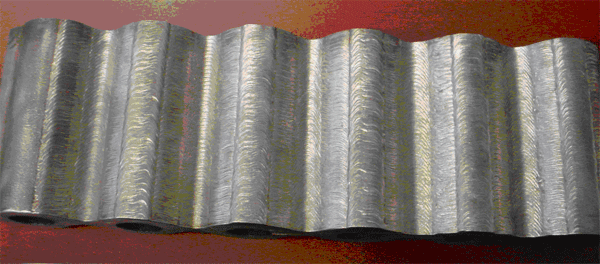
Ed's untouched clad weld cost - quality contribution to the Power and Waste Management Industry.
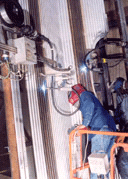
2007: Welding Services (WSI now Aquilex) is the largest power industry contractor in North America. WSI is primarily involved in repairs and refurbishment in the power, waste energy and nuclear industries. In terms of water wall cladding, WSI has clad approx. 80% of the North American boilers. Each year WSI can use approx one million pounds of Inconel 625-622 and 300 series stainless MIG wires for cladding water wall tubes.
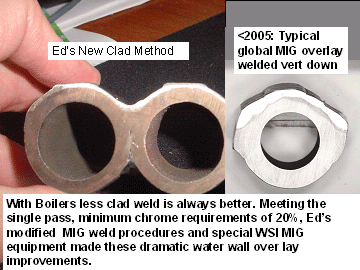
While WSI has produced some of the most innovative, automatic MIG cladding equipment available in North America, WSI did not have a resident MIG process control expert who had the expertise necessary to make the improvements to it's traditional water wall clad MIG welds. Ed was contracted for this work by the WSI engineering manager. In less than 6 months, Ed not only dramatically improved the water wall overlay weld quality but also reduced the amount of costly overlay typically required by> 28%.
As many in the power industry are aware, with any cladding application "less weld and less heat provides the best results. Apart from the high cost of >$20 lb for the Inconel weld wires, the boilers operate more efficiently when the clad surface is thinner and the clad weld pass thickness is uniform and with out defects.
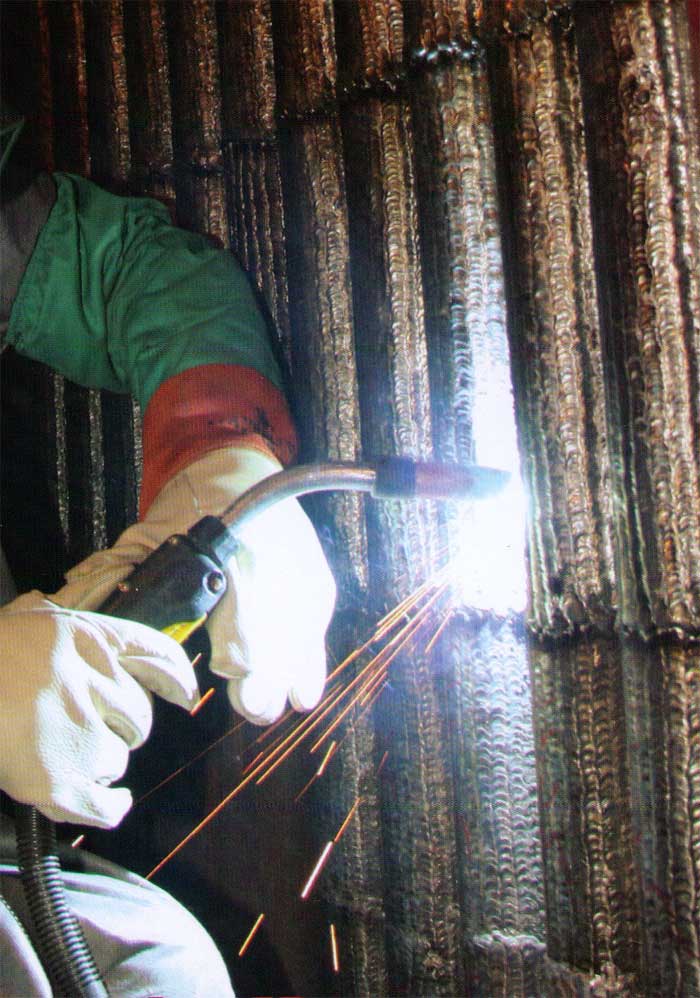
With water wall clad applications, the minimum, single pass weld clad chemistry required is 20% Chrome. To attain the minimum Chrome requirements the pulsed MIG weld procedures had to ensure the weld dilution was less than 8%. The vertical down welds not only have to attain minimum weld dilution with consistent weld fusion on the carbon steel boiler tubes. The weld passes I developed were not only thinner they also supplied an improved transition with the weld pass tie-ins. Of course from a weld productivity perspective, the two gun weld procedure utilized, enabled the single operator to deposit > 26 lbs/hr.
|
|
Note: MIG photo untouched and no weld cleaning except brushing was provided.
With Clad welds on boilers, unless you sell weld consumables, less weld is always better,
|
The vertical down 622 Inconel / stainless clad pulsed MIG welds were derived from a low cost, six thousand dollarpulsed power source selected and re-programmed by Ed and a MIG gas mix also developed by Ed. (See MIG gas data section). These clad welds required 28% less Inconel or stainless per square foot of water wall weld. The welds also required a WSI engineering manager that believed that there was more to MIG clad welding than asking the advice of a Lincoln sales rep, or a welder pulling a gun trigger and applying the typical weld mess. It also helped that WSI had excellent, well designed, patented, automated weld equipment that compensated for the curves (wire stick out voltage variations) when welding of the boiler wall tubes. Ed's clad development was complete in 2006. WSI applied for the US Patent during 2006 and the patent was approved in 2009. Visit the Clad weld section for more info.
Weld Deposition Rates Conversions.
Weld Deposition Rates: = lb/hr x 0.4536 = kg/hr.
Weld Deposition Rates: = 1 lb/ft x 1.49 = kg/m
Weld Deposition Rates: = Ib/in x 17.85 = kg/m.
Weld Deposition Rates: = lb/min x 27.216 = kg/hr.
Weld Deposition Rates: kg/hr x 2.205 = lb/hr.
METRIC TABLES:
Metric and Gas Flow Rates
Flow cuft x 28.317 = liters
Flow 0.47195 liter/min = 1 cuft/hr.
cuft x 1728 = cubic inch.
cuft x 0.02832 = cubic meter.
cuft/hr x 0.4719 = liters/min
cuft/min x 28.31 = liters/min.
liters/min x 2.119 = cuft/hr.
cu/meters/min x 0.002119 = cuft/hr.
cuft x 7.4805 = gal US.
liters x 0.03531 = cuft.
gal/hr x 0.06309 = liter/min
gal/hr x 0.13368 = cuft/hr
gal/min x 8.0208 = cu/ft/hr.
gal/min x 3.785 = liter/min
gal x 3.785 = liter
liters/sec x 127.13 =cuft/hr
Metric and Thermal Conductivity
Joules Per inch = Volts x Amps x 60, Divide by weld speed ipm
Watt per meter kelvin w/m.k
Heat input joules (j) energy J = watts/second
1 watt = 1 joule/sec
1 Kw/hr = 3,600,000
ft/ib = J x 1.356
1 joule = 0.73756 ft/ib.f
j/inch x 39.37 = j/m
j/m x 0.0254 = j/inch
kj/inch x 39.37 = kj/m
Btu x 1054.4 = joules
btu/lb x 2.326 = kj/kg
cal/g x 4.1868 = kj/kg
Metric and Fracture Toughness
Metric Meganewton meter MN.m-3/2
ksi.in 1/2 x 1.099 = MN.m-3/2
MN.m-3/2 x 0.910 = ksi/in �
Metric and Electrode Force
Metric Newton = N
pound force x 4.448ton = newtons
kilogram force x 9.807 = newtons
newton x 0.2248 = lbf
Metric and Area
in/sq x 645.2 = mm/sq
mm/sq x 0.001550 = in/sq
in/sq x 6.451 = cm/sq
ft/sq x 0.09290 = m/sq
Metric and Speed
ipm x 0.4233 mm/sec
mm/sec x 2.362 = ipm
in/sec x 0.0254 = m/sec
ft/sec x 0.3048 = m/sec
ft/hr x 0.00008466 m/sec
ft/min x 0.00508 = m/sec
km/hr x 0.027777 = m/sec
mph x 1.609 = km/h
cm/sec x 1.9685 = ft/min
cm/sec x 0.32808 = ft/sec
m/sec x 196.85 = ft/min
Metric and Impact Strength
Metric = Joules = J
1 ft/lb = 1.355818 J
ft/lb x 0.13825728 = kg/m
Metric and Volume
cu/in x 16.387 = cu/cm
cu/in x 0.00057870 = cuft
cu/in x 0.000016387 = cu/m
cuft x 0.02831 = cu/m
cu/in x 16390.0 = cu/m
cu/cm x 0.000035315 = cuft
cu/cm x 0.061024 = cu/inch
cu/cm x 0.00026417 = gal US
cu/m x 35,315 = cuft
cu/m x 0.00061`024 = cu/inch
liquid gallon to cu/m x 0.003785
Weld Current Density Electrode
Area Square inch Divide by Weld AmpWeld current density metric = amp per square
millimeter = A/mm2
WIRE 0.030 area = 0.00071 in/sq
WIRE 0.8 mm area = 0.00458 cm/sq
WIRE 0.030 area = 0.00071 in/sq
WIRE 0.035 area = 0.00096 in/sq
WIRE 1mm area = 0.006193 cm/sq
WIRE 0.045 area = 0.00160 in/sq
WIRE 1.2mm area = 0.1032 cm/sq
WIRE 0.062 area = 0.00307 in/sq
WIRE 1.6mm area = 0.0198 cm/sq
Metric and Length
1 meter = 3.281 ft
1mm = 0.03937 inch
1inch x 25.4mm
mm x 0.03937 = inch
1 meter x 39.370 inch
ft x 304.8 = mm
mm x 0.003281 = ft
ft x 0.3048 = meter
yard x 0.9144 = meter
Metric and Weight
oz x 0.02834 = kg
lb x 0.4535 = kg
Short ton 2000 lb x 907 = kg
Long ton 2240 lb x 1016 = kg
Tensile strength x 1000 = ksi
Metric Megapascal MPa
I MPa = 145.03 psi
kPa = 0.14503 psi
psi = 0.00689 MPa
mpa x 0.145 = ksi.
ALUMINUM HOW MANY POUNDS OF MIG WIRE REQUIRED?
Aluminum 1/8 3.2 mm fillet = 0.092 lb/ft 0.03 kg/m
Aluminum 3/16 4.8 mm fillet = 0.026 lb/ft 0.04 kg/m
Aluminum 1/4 6.4 mm fillet = 0.05 lb/ft 0.07 kg/m
Aluminum 3/8 9.5 mm fillet = 0.06 lb/ft 0.09 kg/m
Aluminum butt weld 13 mm plate 60 degree single V = 0.3 lb/ft 0.43kg/m
Aluminum butt weld 18 mm plate 60 degree single V = 0.4 lb/ft 0.66kg/m
Aluminum butt weld 25 mm plate 60 degree single V = 0.82 LB/FT 1.2kg/m
Aluminum butt weld 38 mm plate 60 degree single V 1.7 lb/ft 2.6 kg/m
Aluminum butt weld 50 mm plate 60 degre single V 2.8 lb/ft 4.2 kg/m
ALUMINUM "ipm" FEED RATE TO WELD DEPOSITION RATE:
030 0.8 mmwire, ipm x 0.004 = lb/hr
035 0.9 mmwire, ipm x 0.0056 - l/hr
046 1.2mm wire, ipm x 0.0099 = lb/hr
052 1.4mm wire, ipm x 0.012 = lb/hr
062 1.6mm wire, ipm x 0.017 = lb/hr
093 2.4mm wire, ipm x 0.0415 = lb/hr.
ALUMINUM "m/min"FEED RATE TO WELD DEPOSITION RATE:
0.8mm wire, m/min x 0.07 = kg/hr
1 mm wire, m/min x 0.09 = kg/hr
1.2 mm wire, m/min x 0.16 = kg/hr
1.4 mm wire, m/min x 0.23 = kg/hr
1.6 mm wire, m/min x 0.306 = kg/hr
2.4 mm wire, m/min x 0.74 = kg/hr.
|
E-Mail Ed. ecraig@weldreality.com.
For phone weld resolutions call Ed at 828 337 2695.