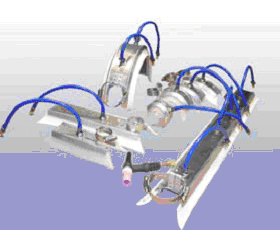
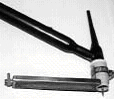
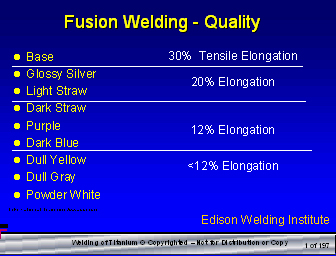
WITH TIP TIG WELDING TITANIUM, GAS TRAILING SHIELDS AS SHOWN ABOVE WILL FREQUENTLY
NOT BE REQUIRED.
BEST WELD PROCESS FOR WELDING TITANIUM IS "TIP TIG WELDING ".
TIP TIG provides superior
Titanium weld quality than traditional TIG or Pulsed MIG welds
If
you want all position, defect free titanium welding at superior quality than conventional
TIG, Pulsed MIG or the flux cored process and you would like to produce all position
weld deposition rates equal to pulsed MIG, consider the TIP TIG
process. A five minute TIP TIG demo will show any weld professional that when
welding in any weld position, thin or thick metals, any alloys and any weld, clad
or brazed application, the TIP TIG process is the world's most cost effective
process for producing defect free welds. THE
NORTH AMERICAN, PATENT PENDING TIP TIG
PROCESS IS THE WORLD'S MOST EFFECTIVE WELD, CLAD AND BRAZING PROCESS. TIP TIG
IS AN EASY PROCESS TO USE ON TITANIUM WELDS AND ALWAYS DELIVERS SUPERIOR WELD QUALITY THAN TRADITIONAL
TIG / PLASMA WELDS. THE BONUS FOR THE WELD SHOP IS WHILE GETTING THE ULTIMATE
IN TIG WELD QUALITY, WITH TIP TIG YOU ARE TYPICALLY GETTING IT 4 TO 8 TIMES FASTER WELDS THAN A REGULAR TIG WELD:
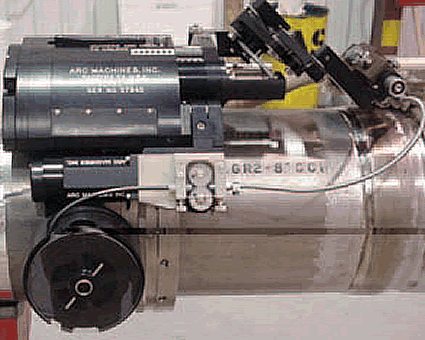
TRADITIONAL ORBITAL TIG ON GRADE 2 TITANIUM
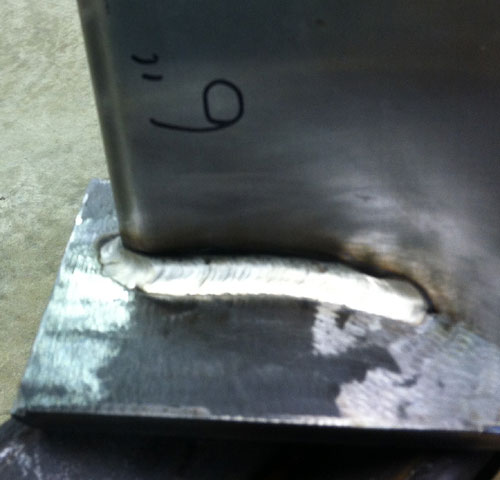
MANUAL TIP TIG ON GRADE 2 TITANIUM
For decades we have had concerns while using the slow TIG process about the oxidation effects on Titanium alloys. Typically manual or mechanized titanium TIG welds on parts over 3 mm will be carried at weld speeds in the 3 to 5 inch/min range. To potect those welds cumbersom trailing shields have been a critical weld requirement.
With either the manual or automated TIP TIG process, the TIP TIG weld speeds are on most titanium applications so much faster that TIP TIG will meet any titanium weld quality requirement and produce the silver or straw color welds with without the use of a trailing shield. If your organization uses regular TIG on Titanium, you will be pleased to know that with TIP TIG, those manual or automated titanium welds will typically be carried at 300 to 800% faster.
As reported in the 2009. September. AWS. Weld Journal, the above orbital Titanium welds are being carried out on US Navy ships.
On one ship approx nine orbital TIG weld units were used on the CP Grade 2 titanium welds. These welds were required on more than 12000 feet of titanium pipe used per ship. For the simple 360 degree titanium TIG orbital lap welds, a weld travel speed of 3- 4 inch/min was reported. Most of us are aware of the heat sensitivity of titanium welds, perhaps the Navy and defence contractors might be interested to know that TIP TIG process would have made the same orbital welds with no quality issues at minimum weld speeds of 20 to 30 inch/min possibly without gas trailing shields.
TIP TIG TITANIUM WELDING WITHOUT A TRAILING SHIELD.
The
Fossil and Nuclear industry will never attain the construction weld quality or
productivity (10 to 40 times faster than manual TIG) that the ATT manual and automated
weld process can deliver. Oil Platforms - Ship Yards - Naval Vessels and Submarines
- The Space and Aircraft Industries - Cryogenic Vessels - Petro Chemical - Refining
- Waste to Energy - Industrial Processing - Pulp and Paper - Military Equipment
- Medical Equipment - Food and Beverage, none of the North American industries
have in their weld shops a weld process that can deliver the weld quality / productivity
attainable from the easy to use, semiautomatic ATT process.
Why be concerned
about the skilled welder shortage when the TIP TIG process is
easy to use on the most difficult applications. PQR's will be easy to produce
as two simple amp / wire feed weld procedures will weld most of your manual or
automated applications. It takes about one hour to learn the one handed TIP TIG
techniques. TIP TIG will dramatically reduce your weld rework costs and reduce
your product liability concerns as it always will deliver the optimum in weld
quality. There is no weld smoke issues and no concerns for spatter. In contrast
to most other process TIP TIG will also provide less weld heat input.
WELD
FACTS FOR TITANIUM:
[] Titanium low weight,
high strength and good corrosion resistance.
[] Titanium
has low thermal conductivity, low density and low thermal expansion.
[]
Titanium alloys match or exceed the tensile strength of structural steels.
[]
Titanium alloys stronger than steel yet approx. 40% lighter.
[] Titanium
will work at temperatures up to 600C.
[] Titanium alloys usually have a
lower modulus of elasticity (stiffness) than steel, but much higher than aluminum
or magnesium.
[] In comparison to aluminum and steel alloys, titanium
alloys have a 30% or greater strength to weight ratio.
[] Most titanium
alloys are softer than steel.
[] Titanium has poor wear properties.
[]
Titanium tensile strength increases as the temperature decreases.
[] Titanium has low impact and
creep strengths.
[] Titanium is reactive metal that forms a thin
layer of titanium dioxide on it's surface. The oxide provides protection from
many corrosives materials.
[] Titanium is bio-compatible in that it does
not react with the human body.
[] Titanium will burn in pure nitrogen.
Contamination
during the high temperate period can raise the transition temperature so that
the material is brittle at room temperatures. If contamination occurs so that
transition temperature is raised sufficiently, it will make the welding worthless.
Gas contamination can occur at temperatures below the melting point of the metal.
These temperatures range from 700°F (371°C) up to 1000°F (538°C).
At room temperature, titanium has an impervious oxide coating that resists
further reaction with air. The oxide coating melts at temperatures considerably
higher than the melting point of the base metal and creates problems. The oxidized
coating may enter molten weld metal and create discontinuities which greatly reduce
the strength and ductility of the weld.
Titanium Property Values [] Melting point 1933 K [] Boiling Point 3560 K []
Tensile strength 234 MPa [] Yield strength 138 MPa
No other process can provide the titanium weld quality that the TIP TIG process can provide.
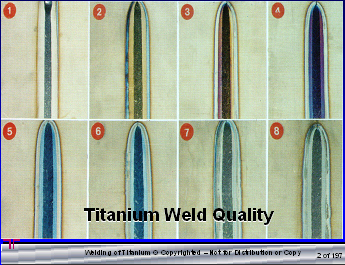
TITANIUM WELDABILITY CHART. 1-2. SILVER AND STRAW PREFERRED.
Silver and straw without a trailing shield is commom with TIP TIG
Common
Titanium Alloys:
The
following are the common titanium alloys. Selecting base titanium metals or titanium
weld filler metals to meet specific corrosion or mechanical properties requires
many considerations, if you need this material data I recommend you check in with
the International Titanium Association www.titanium.org--
http://www.titaniuminfogroup.co.uk.
www.timet.com
For Titanium electrode
data check with any titanium electrode manufacturer. Filler materials used for
Welding-titanium alloys are described in AWS 5.16 - Specification for Titanium
and Titanium Alloy Weld Electrodes and Rods.
The
maximum useful temperature range for titanium structural applications is 800 to
1100 0F, depending on the selected alloy and it's condition. Titanium is used
in cryogenic applications as it has no dangerous ductile-brittle transition temperature.
Unalloyed titanium is usually selected for its excellent corrosion resistance,
especially in applications where high strength is not required. Besides the unalloyed
or commercial titanium, different classes of titanium alloys are described by
reference to metallurgical types called alpha, alpha-beta and beta, which indicate
the main phases present in the microstructure.
The
two most common titanium grades are commercially pure titanium ASTM grade 2 (corrosion
resistant) with strength 350 - 450 MPa, and higher strength titanium alloys Ti-6AI-4V
that provide strength in the 900 - 1100 MPa range.
Commercially
pure titanium alloys: Examine the corrosion resistance and mechanical properties
of the many grades available.
The commercially pure (C.P) alloys
are widely used for industrial applications as a results of the combinations of
good weldability, strength, corrosion resistance and formability.
ASTM
Grades 1 -2 - 3 - 4. (alpha) are commercially pure and typically used for their
corrosion resistance.. Each of these grades has a different amount of impurity
content. Grade 1 is the the most pure. The mechanical properties increase with
the grade number.
ASTM Grades 7 - 11 - 16 - 17 are also alpha titanium
that contain palladium, these grades have excellent corrosion resistance, while
grades 26 and 27 provide even greater corrosion resistance. There are many other
grades available.
When
welding CP alloys you would typically utilize a weld wire one or two PSI strength
grades lower than the parent metal. The weld dilution with the base metal along
with micro contaminants from the base will l increase the strength of the weld
metal. One of the important benefits of welding the commercially pure grades of
titanium is that they are over 99% pure titanium and there is no concern for segregation.
The same is true for commercially pure weld wire or rod.
Unalloyed
grades include about 30% of titanium production. Unalloyed titanium are generally
weldable and welded joints generally have acceptable strength and ductility. Postweld
stress-relief annealing of weldments is recommended.
Alpha
titanium alloys:
Alpha
alloys are predominantly alpha, usually with small amounts of beta present. Alpha
alloys typically contain aluminum and tin, and they can also contain molybdenum,
zirconium, nitrogen, vanadium, tantalum, columbium, and silicon. These alloys
are weldable in annealed condition and retain their strength at high temperature.
They do not generally respond to heat treatment however they can be strengthened
by cold work ( strain hardening) and are commonly used for chemical processing,
cryogenic applications and airplane parts.
Beta
titanium Alloys:
The
Beta alloys are the smallest group of titanium alloys. These alloys have good
hardenability. They have good cold formability when they are solution-treated,
and high strength when aged. Beta alloys are slightly denser than other titanium
alloys. These weldable alloys are the least creep resistant alloys, they can provide
yield strengths up to 1345 MPa.
Alpha-Beta
titanium Alloys:
Alpha-beta
alloys contain both phases, with more beta than the alpha alloys.Titanium alpha-beta
alloys can be welded in certain conditions but with limited weld ductility or
heat affected zone ductility, however these alloys can be strengthened by heat
treatment. In contrast to the Alpha alloys, the Alpha-Beta alloys can be strengthened
by heat treatment and aging. The Alpha-Beta alloys can undergo machining / manufacturing
while the material is still ductile, and then be heat treated to strengthen the
material, which is a major advantage. The alloys are commonly used in aircraft
and aircraft turbine parts, chemical processing equipment, prosthetic devices
and marine parts.
Ti-6Al-4V is a common titanium alloy. These alloys are weldable in the annealed
condition as well as in the solution treated and partially aged condition (aging
can be completed during the post-weld heat treatment). Strongly stabilized alpha-beta
alloys can be embrittled by welding, the result of phase transformations occurring
in the weld metal or the heat affected zone.
ASTM.
Titanium Welding Specifications:
[]
B265 Strip Sheet and Plate. [] B337 Seamless and Welded Pipe. [] B338 Seamless
and Welded Tubes. [] B348 Bars and Billets. [] B363 Seamless and Welded
Fittings. [] B367 Castings. [] B381 Forgings. [] B861 Seamless Pipe replaces
B 337 [] B862 welded Pipe. [] B863 Wire. [] F 67 Unalloyed Titanium for
Surgical Applications. [] Ti-6AI-4V Surgical Applications.
The
world's best manual / automated welding process for Titanium. is a new
weld
process introduced in the USA 2009, its called Advanced
TIP TIG.
HAZARDS
OF WELDING TITANIUM - SAFETY CONSIDERATIONS:
Storage
of titanium chips from machining operations is relatively safe. The storage of
fine titanium powder can be fire or explosion hazard. Avoid weld
sparks or flames around titanium dust. If a fire does start with the titanium
after product and its safe to do so, try to isolate the burning material from
the bulk of the scrap. A titanium fire can be extinguished using either a Class
D extinguisher or dry powder. A sodium chloride base powder or salt / sand can
be used to reduce the oxygen.
Give
consideration to the collection or storage of titanium chips and the dust from
machining operations. The chips are relatively safe, the concern should be for
the titanium dust / powders which could create either a fire or explosion. Fires
or explosions may be initiated by exposing a flammable concentration of titanium
dust to grinding / weld sparks spark or a naked flame. If a fire does start, try
to isolate the burning materials from the rest of the materials. A titanium fire
will be extinguished using either dry powder (sodium chloride, salt sand) or a
class D fire extinguisher.
From
Lancaster Alloys: The possibility of spontaneous ignition of titanium or its alloys
during welding is extremely remote. Like magnesium or aluminum the occurrence
of fires is usually encountered where accumulation of grinding dust or machining
chips exists. Even in extremely high surface-to- volume ratios, accumulation of
clean titanium particles do not ignite at any temperature below incipient fusion
temperature in an ambient atmosphere. However, spontaneous ignition of fine grinding
dust or lathe chips, saturated with oil under hot humid conditions have been reported.
Water or water-based coolants should be used for all machining operations. Carbon
dioxide is also a satisfactory agent. Large accumulations of chips, turnings,
or other metal powders should be removed and stored in enclosed metal containers.
Dry grinding should be done in a manner that will allow proper heat dissipation,
with the powder similarly stored in enclosed containers.
Dry compounds
extinguishing agents or dry sand are effective fire extinguishing agents. Ordinary
extinguishing agents such as water, carbon tetrachloride, and carbon dioxide foam
are ineffective in extinguishing titanium fires.
The
toxicity and related health problems associated with Titanium Tetrachloride are
discussed by the Agency for Toxic Substances and Disease Registry. http://www.atsdr.cdc.gov/tfacts101.html.
http://www.corrosion-doctors.org/ MatSelect/corrtitanium.htm describes the
corrosive effects of some chemicals with titanium.
The
nitric acid used to pre-clean titanium for inert gas shielded arc welding is highly
toxic and corrosive. Goggles, rubber gloves, and rubber aprons must be worn when
handling acid and acid solutions. Do not inhale gases and mists. When spilled
on the body or clothing, wash immediately with large quantities of cold water,
and seek medical help. Never pour water into acid when preparing the solution;
instead, pour acid into water. Always mix acid and water slowly. Perform cleaning
operations only in well ventilated places.
The
caustic chemicals (including sodium hydride) used to preclean titanium for inert
gas shielded arc welding are highly toxic and corrosive. Goggles, rubber gloves,
and rubber aprons must be worn when handling these chemicals. Do not inhale gases
or mists. When spilled on the body or clothing, wash immediately with large quantities
of cold water and seek medical help. Special care should be taken at all times
to prevent any water from coming in contact with the molten bath or any other
large amount of sodium hydride, as this will cause the formation of highly explosive
hydrogen gas.
TIG
OR TIP TIP TIG WELDING TITANIUM BEST PRACTICES. THINK CLEAN: Titanium
weld joints are similar to those for other metals, and the edge preparation is
commonly done by machining or grinding. In welding Titanium cleanliness is always
vital and of course the parts have to be spotless, however give also consideration
to the influence of the surrounding atmosphere as this needs consideration. Aggressive
wire brushing of the base metal in the weld area using a stainless steel brush
designated solely for the titanium only. Use of high-purity acetone for cleaning
both the titanium surfaces to be welded and also when TIG
welding for the surface of the weld filler wire. Maintaining cleanliness enables
manufacturers to avoid porosity and a loss of toughness typically associated with
contaminates and titanium welds.. Treat
the Titanium TIG welded part as a surgeon should treat a patient.
[]
Wear white cotton gloves when handling the parts.
[] Store parts in clean
dry area.
[] Don't store parts unless they are wrapped and sealed from
the atmosphere.
A separate highly clean area in the weld shop should be used
for welding the titanium. The clean area should be isolated from dirt-producing
operations such as grinding, painting machining torch cutting and painting.
[]
The weld area should be free of air drafts and the humidity should be controlled.
[] Remember grinding dust and particle contaminates from the weld smoke
can end up on the Titanium surface, this will cause weld issues.
[] Any
oxide layer must be removed from the titanium surface by grit blasting or pickling.
[] Contaminants such as grease, oils, marker pens and even fingerprints
should be removed from any area subject to >400 C, clean with detergent cleaners
or non-chlorinated solvents.
[] To
clean the parts. Chlorinated Fluoro Carbon solvents are forbidden for cleaning
titanium and titanium alloys because they produce embrittlement. Use instead only
Acetone or Methyl Ethyl Ketone (MEK).
[] To clean the welds, a new dedicated
stainless steel brush should be used to clean the weld joint and immediate area
surface.
[] Take care of those stainless cleaning brushes. After use,
the stainless brushes should be rinsed in alcohol and stored in a sealed container.
Always remember the weld color indicates the success of your cleanliness.
[]
Light surface oxides can be removed by acid pickling while heavier oxides on the
surface could require you grit blast then pickle the part.
[] Keep in
mind that clamps and fixtures in the proximity of the parts that are in the heat
sensitive zone of > 400C. can also contaminate the parts.
[] The weld
wire used should not be left in the open, store in a sealed dry area and use clean
cotton gloves or new weld gloves if handling.
Lancaster
Alloys Provides the following advice on cleaning titanium.
[]
Surface cleaning is important in preparing titanium and its alloys for welding.
Proper surface cleaning prior to welding reduces contamination of the weld due
to surface scale or other foreign materials. Small amounts of contamination can
render titanium completely brittle.
[] Several cleaning procedures are
used, depending on the surface condition of the base and filler metals. Surface
conditions most often encountered are as follows:
(a) Scale free (as received
from the mill).
(b) Light scale (after hot forming or annealing at intermediate
temperature; ie., less than 1300°F (704°C).
(c) Heavy scale (after
hot forming, annealing, or forging at high temperature).
[]
Metals that are scale free can be cleaned by simple decreasing.
[] Metals
with light oxide scale should be cleaned by acid pickling. In order to minimize
hydrogen pickup, pickling solutions for this operation should have a nitric acid
concentration greater than 20 percent. Metals to be welded should be pickled for
1 to 20 minutes at a bath temperature from 80 to 160°F (27 to 71°C). After
pickling, the parts are rinsed in hot water.
A
common pickling solutions of 48 %hydrofluoric acid concentration and 70% nitric
acid concentration. The acid ratio 1:5 and 1:9 is effective.
[] Metals
with a heavy scale should be cleaned with sand, grit, or vaporblasting, molten
sodium hydride salt baths, or molten caustic baths. Sand, grit, or vaporblasting
is preferred where applicable. Hydrogen pickup may occur with molten bath treatments,
but it can be minimized by controlling the bath temperature and pickling time.
Bath temperature should be held at about 750 to 850°F (399 to 454°C).
Parts should not be pickled any longer than necessary to remove scale. After heavy
scale is removed, the metal should be pickled as described in (4) above.
[]
Surfaces of metals that have undergone oxyacetylene flame cutting operations have
a very heavy scale, and may contain microscopic cracks due to excessive contamination
of the metallurgical characteristics of the alloys. The best cleaning method for
flame cut surfaces is to remove the contaminated layer and any cracks by machining
operations. Certain alloys can be stress relieved immediately after cutting to
prevent the propagation of these cracks. This stress relief is usually made in
conjunction with the cutting operation
TITANIUM
BEST PRACTICES AND WELDING GAS FACTS:
Properly
shielded titanium welds will be bright and silvery in appearence. The quality
and coverage of the shielding gas is an extremely important factor for welding
titanium. When titanium is subject to heat above 400oC it reacts with the atmosphere
oxygen, nitrogen and also will react with carbon and contaminate. If the contaminants
are absorbed into the weld, the results can be porosity and low-notch toughness
and brittleness. It's essential that adequate inert shielding gas covers the molten
weld pool and all areas above 400oC to ensure a good quality weld.
To
prevent contamination between the atmosphere and the hot metal and welds, the
inert argon or helium must be free of contaminates. The use of -300F liquid argon
containers is preferable to traditional, high pressure cylinder grade argon which
may contain possible contaminates and moisture in the gas. If cylinder gases are
used, consider the use of specialty gas argon and order ultra high quality grade
and dont use cylinder gas mixes below 300 psi as the moisture content rises with
pressure drop.
Its recommended to weld small parts in a purge chamber.
It's important to supply the inert gas at the correct flow rate to any
side of the titanium parts that are heated above 400°C. A grooved drilled
copper back bar fed with argon is effective in shielding the under bead against
contamination. On narrow parts remember the part's sides may also need atmospheric
protection also. The thinner the part the wider the affected heat zone, the wider
the gas coverage.
Huntingdon
Traliing Gas Shields for welding TIG / MIG
Always
ensure that the inert atmosphere protection is maintained until the weld metal
temperature cools well below 426°C (800°F), keep those 300C tempsticks
handy.
With
TIG Titanium welds use 20 cuft/hr, with MIG Titanium welds use 40 cuft/hr.
Remember
helium when used can change the weld penetration profile. Helium is also lighter
than air and the smaller helium molecules do not have the oxide cleaning action
that larger argon molecules do. If you add helium to argon a good mix in which
you can attain the benefits of both gases, is 60% Argon 40% helium.
Titanium welds typically require three separate
gas streams during MIG or TIG welding.
Because
of the low thermal conductivity of titanium the molten puddle tends to be larger
than most metals. For this reason and because of shielding conditions required
in welding titanium, larger MIG and TIG nozzles are used on the welding torch,
with proportionally higher gas flows that are required for other metals.
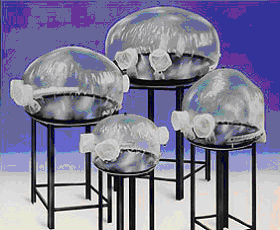
Water-cooled
copper backup bars may also be used as heat sinks to help chill the welds. These
bars are usually grooved, with the groove located directly below the weld joint.
The backup bars provide around 10 cfh of inert gas flow for adequate shielding.
Note:
Chill bars often are used for faster cooling and to limit the size of the weld
puddle.
For
the back up gas and trailing gas shield, typically start out at 10 cuft/hr. The
color of the welds will indicate the effectiveness and desired length and width
of the trailing shield apparatus. Ensure the purge gas flow rates are sufficient
to exclude air but not so great as to cause turbulent in the flow. Gas control
is assisted and turbulence minimized by adjusting gas flows and by placing baffles
alongside the welds. Baffles protect the weld from drafts and tend to retard the
flow of shielding gas from the joint area.
Weld
contamination which occurs in the molten weld puddle is especially hazardous.
The impurities go into solution, and do not cause discoloration. Although discolored
welds may have been improperly shielded while molten, weld discoloration is usually
caused by contamination which occurs after the weld has solidified.
Use
of backing fixtures can be eliminated in many cases by the use of weld backup
tape. This tape consists of a center strip of heat resistant fiberglass adhered
to a wider strip of aluminum foil, along with a strip of adhesive on each side
of the center strip that is used to hold tape to the underside of the tack welded
joint. During the welding, the fiberglass portion of the tape is in direct contact
with the molten metal, preventing excessive penetration. Contamination or oxidation
of the underside of the weld is prevented by the airtight seal created by the
aluminum foil strip. The tape can be used on butt or corner joints or, because
of its flexibility, on curved or irregularly shaped surfaces. The surface to which
the tape is applied must be clean and dry. Best results are obtained by using
a root gap wide enough to allow full penetration. .
Test
both the weld and shielding gases before welding. A simple weld test is to make
a weld bead on a piece of clean scrap titanium, and notice its color. The resulting
weld bead should be shiny. Any discoloration of the surface indicates a contamination.
For
welding small parts and you want gas protection give Huntingdon a call.
Best
Weld Practices and MIG / TIG Titanium Welding.
Most
of the titanium alloys which are being used in arc welding applications are available
as a wire for use as welding filler metal. These alloys are listed below: For
more filler wire data contact a reputable weld wire supplier:
ASTM
grades with good weldability. 1-2-3-4-7-9-11-12-13-14-15-16-17-18-21-26-27-28-6.6ELI
ASTM
grades medium to fair weldability 5-23-24-29
(a)
Commercially pure titanium --commercially available as wire.
(b) Ti-5A1-2-1/2Sn
alloy --available as wire in experimental quantities.
(c) Ti-1-1/2A1-3Mn
alloy --available as wire in experimental quantities.
(d) Ti-6A1-4V alloy
--available as wire in experimental quantities.
(e) There has not been
a great deal of need for the other alloys as welding filler wires. However, if
such a need occurs, most of these alloys also could be reduced to wire. In fact,
the Ti-8Mn alloy has been furnished as welding wire to meet some requests. (Lancaster
Alloys).
Mention
welding titanium and for many weld decision makers their is unnecessary concern.
From a welding perspective, TIG or MIG welding Titanium has a lot in common with
TIG or MIG welding stainless steels. The primary concern when welding titanium
is that both the weld and surrounding metal must be meticulously clean and be
totally protected from the reactive gases of the atmosphere. Typically inert argon,
helium or a vacuum unit is used for this protection. The atmospheric protection
must be provided to all sides of the parts that are subject to temperatures above
800F or 426C.
[]
Welding pure titanium, use a pure titanium wire. If welding a titanium alloy,
the next lowest strength alloy should be used as a filler wire. The weld deposit
will pick up through dilution the required strength. The same considerations are
true when MIG welding titanium.
[]
Don't weld titanium unless you know the alloy and have checked the last heat treatment
that was performed.
[]
Heating titanium in air at high temperature not only is an oxidation concern but
also be concerned about the solid-solution hardening that can result on the surface
thanks to a diffusion of both oxygen and nitrogen. A surface hardened zone of
"alpha-case" is formed. This layer must be removed, before placing a
part in service, by machining, chemical milling, or other means. If not removed
, because its presence reduces fatigue strength and ductility.
[] Welding
titanium to most dissimilar metals is not feasible as the titanium forms brittle
compounds with most other metals. The exception is titanium can be welded to tantalum,
zirconium and niobium. Some of the different grades of titanium can be welded
to each other. When using no filler for those titanium welds, the autogenous welds
that result typically will have properties that are the average of the two parent
metals. To join dissimilar metals to titanium, adhesives, mechanical fastening,
explosive or frictional welds may be utilized.
[] Reaction of the titanium
with both gases and fluxes is one of the reasons oxy fuel welding, flux cored,
SAW` or the SMAW processes are not suited. However new gas shielded flux cored
wires are under development in 2006, its hoped these wires and the resulting slag
will reduce the need for trailing gas concerns. Titanium can be joined by the
conventional processes such as TIG - Plasma - MIG - Pulsed MIG - Resistance
- Friction - Electron Beam - Laser Titanium Welding and others.
[] When using TIG to weld titanium, the DCEN process is utilized usually argon
and the use of high frequency for the arc initiation. Avoid scratch starts as
the tungsten can contaminate the titanium. Two percent ceriated or two percent
lanthanated tungsten electrodes are recommended. These electrodes will not spit
or split, have low erosion rates, and provide consistent arc starts over a wide
amp.
[]
Before starting an arc in MIG or TIG welding titanium, its good practice for at
least 10 seconds to pre-purge the TIG torch or MIG gun. Also pre-purge the trailing
shields and backup shields.
[]
A common sense process approach to welding titanium is to always use use the lowest
weld parameters that will sustain consistent weld fusion. Think fast cooling,
always be concerned with putting excess heat to the parts.
[]
Interpass weld temperatures should be kept below < 200F.
[]
When extinguishing the TIG arc use current downslope and the gas shielding should
be continued until the weld metal and surrounding area cools well below 700F.
Secondary and backup shielding should also be continued. A straw or blue color
on the weld is indicative of early removal of shielding gas.
[] If possible
on the fixtures use heat sink copper materials to speed the heat quench times.
[]
Give consideration to the TIG arc length for welding titanium. When no filler
is used the arc length should be approx. equal to the tungsten electrode diameter.
If TIG electrode wire is added, the max TIG arc length should be about 1.5 times
the electrode diameter. When adding TIG filler the weld wire should be fed into
the weld zone at the leading edge of the weld pool. The TIG wire should be fed
continuously into the puddle. Do not use intermittent dipping technique as possible
weld pool turbulence can result.
[] A water-cooled welding torch is typically
used and ensure extra large gas nozzle / diffusers are used. A 3/4-inch or one-inch
ceramic cup and a gas lens, is recommended for TIG welding and a minimum one-inch
cup may be required for MIG welding.
[] Thoriated tungsten electrodes
(usually 2% thoria) are recommended for GTA welding of titanium.
[] Pointed
TIG electrodes with an optimum 60 degree cone, try a slight blunt end as it may
prolong the tungsten life.
[] For TIG use the smallest diameter electrode
which can carry the required current should be used.
[]
Welding-titanium should be followed by stress relieving in order to prevent cracks,
and also to avoid stress corrosion cracking in service.
[]
Remember with TIG there is opportunity for possible contamination of the hot end
of the wire is removed from the gas shield. The contaminants will then be transferred
to the weld puddle. Whenever the TIG weld wire is removed from the inert gas shielding,
the end of the wire should be clipped back about 25 mm to remove contaminated
metal.
[] Plasma welding offers DCEN TIG quality with key hole full penetration
AUTOGENEOUS single pass weld capability that offers many benefits.
[] Pulsed
MIG is an excellent choice for titanium and far more economical than TIG. Consider
an argon 30 to 40% helium mix to help stabilize the weld arc.
[]
The filler wire selection to weld the commercially pure grades will typically
depend on the mechanical properties that are required from the welds, (ductility
/ strength).
[]
The most common weld processes most commonly used for the fabrication of thin
titanium or small weld is the TIG and Plasma processes. The MIG spray or pulsed
MIG modes are the process of choice for thicker titanium welds. Pulsed MIG welds
can offer much lower weld joules than spray transfer. []
Porosity in titanium welds is a common problem. Porosity is usually caused by
gas bubbles formed from contaminates during the weld solidification. It goes back
to gas coverage, cleanliness and avoid weld turbulence.
Foreign materials on
the surface of the weld wire and contaminates in cylinder gases are two primary
causes of weld porosity and weld embrittlement.
The weld wire comes to
you with both surface and subsurface inclusions that results during the weld filler
wire during drawing. The wire lubricants and micro contaminates are a major cause
of weld porosity. Check out your weld wire supplier and the quality system they
use to provide clean wires.
Because
of the low thermal conductivity of titanium, weld beads tend to be wider than
normal. However, the width of the beads is generally controlled by using short
arc lengths, or by placing chill bars or the clamping toes of the jig close to
the sides of the joints.
How many thousands of soldiers were needlessly killed while traveling
in the biggest weapon of mass destruction in the Iraq war, the "Humvee"
The Humvees lacked the armor protection they required. The Humvees actually
lacked less protection than the army troop carriers used in the second world war.
While
scrimping on armor protection for the troops, the army brass asked the American
tax payers to shell out for tremendously expensive howitzers made from titanium.
Why titanium? The army generals wanted the howitzers to be lighter, so they would
be less strain on the equipment lifting or pulling them. One could easily get
the impression that the generals were more worried about the wear on their trucks
and helicopters than they were about the life's of their soldiers in the pathetic
vehicles called the Humvee.
Remember in the good old days horses used
to pull howitzers. God help the soldiers in the Humvees and god help the soldiers
who have to do the titanium weld repairs on the howitzers.
Best
Practices and Weld Quality Evaluation.
The
visual inspection of the color of titanium welds and parts, is a great indication
of the resulting weld / part integrity. A macro examination of that titanium
weld will
typicaly reveal weld defects such as porosity, undercut, lack of
root or side wall fusion.
TITANIUM WELD COLOR
TITANIUM WELD QUALITY
BRIGHT SILVER
ACCEPT BUT REMOVE DISCORATION IF MULTI-PASS WELDS
SILVER
ACCEPT BUT REMOVE DISCORATION IF MULTI-PASS WELDS
LIGHT STRAW
ACCEPT BUT REMOVE DISCORATION IF MULTI-PASS WELDS
DARK STRAW
ACCEPT BUT REMOVE DISCORATION IF MULTI-PASS WELDS
BRONZE
ACCEPT BUT REMOVE DISCORATION IF MULTI-PASS WELDS
BROWN
ACCEPT BUT REMOVE DISCORATION IF MULTI-PASS WELDS
VIOLET
UNNACEPTABLE. REMOVE IF MULTI-PASS WELDS
DARK BLUE
UNNACEPTABLE. REMOVE IF MULTI-PASS WELDS
LIGHT BLUE
UNNACEPTABLE. REMOVE IF MULTI-PASS WELDS
GREEN
UNNACEPTABLE. REMOVE IF MULTI-PASS WELDS
GREY
UNNACEPTABLE. REMOVE IF MULTI-PASS WELDS
WHITE
UNNACEPTABLE. REMOVE IF MULTIPASS WELDS
A
positive feature of welding titanium is the color of the weld beads will give
a good indication of the effectiveness of the inert gases on protection of the
parts from the atmospheric gases.
The aim when welding titanium should
always be to produce a bright silver weld. Any discoloration outside the silver
weld indicates that some reaction with oxygen has occurred either during the actual
welding or during the cool down period.
Any weld discoloration should
be cause for stopping the welding operation and correcting the welding problem. Light
straw-colored weld discoloration can be removed by wire brushing with a clean
stainless steel brush, and the welding can be continued. Dark blue oxide or white
powdery oxide on the weld is an indication of a seriously deficient purge. When
the discoloration takes place, stop welding immediately and review the causes
of the oxide reaction.
For
the finished weld, nondestructive examination by liquid penetrant, radiography
and/or ultrasound are normally employed in accordance with a suitable welding
specification. At the outset of welding it is advisable to evaluate weld quality
by mechanical testing. This often takes the form of weld bend testing, sometimes
accompanied by tensile tests.
Titanium
Welding defects.
Defects
in arc welded joints in titanium alloys consist mainly of porosity and cold cracks.
Weld penetration can be controlled by adjusting welding conditions.
Titanium Weld Porosity. Weld porosity is a major problem in arc welding titanium
alloys. Although acceptable limits for porosity in arc welded joints have not
been establish, porosity has been observed in tungsten-arc welds in practically
all of the alloys which appear suitable for welding operations. It does not extend
to the surface of the weld, but has been detected in radiographs. It usually occurs
close to the fusion line of the welds. Weld porosity may be reduced by a slight
agitation of the molten weld puddle and adjusting welding speeds, (slow down).
Also, remelting the weld will eliminate some of the porosity present after the
first pass. However, the latter method of reducing weld porosity tends to increase
weld contamination.
Titanium Weld Cracks.
With
adequate shielding procedures and suitable alloys, cracks should not be a problem.
However, cracks have been troublesome in welding some alloys. Weld cracks are
attributed to a number of causes. In commercially pure titanium, weld metal cracks
are believed to be caused by excessive oxygen or nitrogen contamination. These
cracks are usually observed in weld craters. In some of the alpha-beta alloys,
transverse cracks in the weld metal and heat affected zones are believed to be
due to the low ductility of the weld zones. However, cracks in these alloys also
may be due to contamination. Cracks also have been observed in alpha-beta welds
made under restraint and with high external stresses. These cracks are sometimes
attributed to the hydrogen content of the alloys. If weld cracking is due to contamination,
it may be controlled by improving shielding conditions. However, repair welding
on excessively contaminated welds is not practical in many cases.
Cracks which are caused by the low ductility of welds in alpha-beta alloys can
be prevented by heat treating or stress relieving the weldment in a furnace immediately
after welding. Oxyacetylene torches also have been used for this purpose. However,
care must be taken so that the weldment is not overheated or excessively contaminated
by the torch heating operation.
Cracks
due to hydrogen may be prevented by vacuum annealing treatments prior to welding.
NDT:
Traditional radiography is used to detect lack of root or sidewall fusion, weld
porosity or tungsten inclusions. Standard NDT methods of weld inspection are utilized
such as dye pen, ultrasonic, fluorescent crack detection and acoustic emission.
Contact
your weld wire supplier for as welded tensile and charpy impact properties of
the common alloys. A common method of comparing the ductility of welds in sheet
materials of various alloys is the bend test. The minimum bend radius for titanium
welds is defined as the minimum radius around which a sample of titanium containing
a weld can be bent without developing a crack, divided by the thickness of the
material. Normally, the sample is bent until the permanent deformation equals
105° with the weld transverse to the bend axis. The actual bend is often much
greater then 105° because of the "springback" encountered in titanium
alloys. Typical minimum bend radiuses are given by companies like Lancaster Alloys.
Bend
or notch toughness tests are the best methods for evaluating the gas shielding
conditions. Hardness measurements
on weld vs. base metal are also sometimes used as an indicator of weld quality.
Normally, uncontaminated weld hardness is no more than 30 points greater on the
Knoop, Vickers or Brinell hardness scales (5 points Rockwell B) than the hardness
of base metal of matching composition.
It should be recognized that heat-to-heat
variation in chemistry, within specifications, can result in hardness differentials
somewhat higher than 30 Knoop or Brinell without any contamination. In any event,
high weld hardness should be cause for concern because of the possibility of contamination.
TITANIUM
HARDNESS: The
ASME Code suggests that, if the weld metal hardness is more than 40 BHN greater
than base metal hardness, excessive contamination is possible. Substantially greater
hardness differential necessitates removal of the affected weld-metal area. The
Code further specifies that all titanium welds be examined by liquid penetrant.
In addition, full radiography of many titanium joints is required by the Code
Heat treatment of
titanium welds is not normally necessary. Annealing may be necessary following
severe cold work if restoration of ductility or improved machinability are desired.
A stress relief treatment is sometimes employed following severe forming or welding
to avoid cracking or distortion due to high residual stresses, or to improve fatigue
resistance.
Note: Cleanliness of
titanium parts to be heat treated is important because of the sensitivity of titanium
to contamination at the heat treated elevated temperatures. Titanium fabrications
should be cleaned carefully prior to heating, using nonchlorinated solvents or
a detergent wash, followed by a thorough water rinse. Handling following cleaning
should be minimized to avoid potential surface contamination.
Most
titanium grades are typically stress-relieved at about 1000°F (538°C)
for 45 minutes and annealed at 1300°F (704°C) for two hours. A slightly
higher stress relief temperature [1100°F (593°C), 2 hrs.] and annealing
temperature [1450°F (788°C), 4 hrs.] are appropriate for the Grade 5 alloy.
Air cooling is generally acceptable.
Thanks
to the International Titanium Association for allowing reproduction of this
important color chart.