Panasonic
welding equipment issues
and lack of weld process expertise:
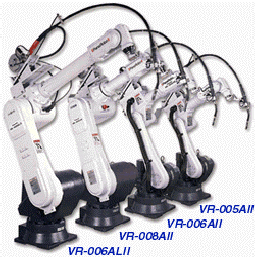
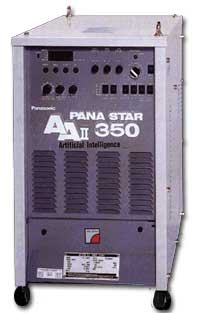
The
company I visited welds 6xxx series, extruded aluminum, thin gage parts. They
had purchased a Panasonic VR OOGAL 11robot, with a Panasonic 350 amp Panastar
RA 350 pulsed power source.
For the welds they used a 0.046, 4043 wire
and argon. The MIG wire spool was mounted on top of the robot, and they used a
regular four-drive roll feeder with a standard water-cooled gun.
The
problem robot welds were short lengths 5/8 to ¾ long. The robot welds are
made on aluminum square tubes 0.070 thick. The 6xxx tubes are welded to a thicker
alum part 3/16 thick. Since they purchased the robot the completed welds never
look consistent over their short lengths. All the thin tube welds were made with
the same weld data, yet in the same locations on the parts, some welds look fluid
while other welds look cold.
Most of the welds ended up with a black
and dirty appearance yet the push gun angle is correct. These welds caused so
many issues the company was ready to give up the robot and go back to manual GTAW.
The reason the company purchased this robot, is the owner of the company
took some sample alum parts to the AWS weld show. At the show a Panasonic rep
impressed the owner by producing some “manual weld samples". On these
samples the welds were approx. four to six inches in length. In the 12 months
since this company purchased the robot, they have never produced a part with welds
that look as good as the weld show samples.
Panasonic experts and and
the robot integrator personnel spent many weeks at this company and they did not
resolved the welding issues or provide an analysis of the cause.
THE FRUSTRATED CUSTOMER ASKED ME TO REVIEW THIS PANASONIC ALUMINUM APPLICATION.
 After
evaluating the equipment, process and application, I optimized the weld data and
then found the primary problem to be with the Panastar,
RA 350, pulsed power source
and its response time with the robot. A factor few power source manufacturers
rarely give consideration to is response time. This is a critical element
on robot welds in which the weld cycle times are less than 3 seconds.
After
evaluating the equipment, process and application, I optimized the weld data and
then found the primary problem to be with the Panastar,
RA 350, pulsed power source
and its response time with the robot. A factor few power source manufacturers
rarely give consideration to is response time. This is a critical element
on robot welds in which the weld cycle times are less than 3 seconds.
It
takes time for a robot interface to communicate to a MIG power source.
The robot interface has to inform the power source of the required, weld start
data which then needs “time” to change to the weld data, which
then needs time to figure out and stabilize the pulsed data, after which
time is required for a diagnostic check and time to change to
the weld end data.
In
the days when Panasonic was struggling to make a pulsed power source that could
actually provide consistent pulsed welds (see MIG equipment and pulsed sections),
the response times of communication between the power source and robot may not
have been a priority concern for Panasonic.
From
the weld perspective aluminum is unique in that time is also required with
the weld for the MIG arc plasma to break the aluminum surface oxides and provide
an oxide free area for the weld. Also because of the conductivity of aluminum
it takes a specific amount of time for each weld (depending on the heat
in the part) for the aluminum to become fluid so the weld can proceed.
The
pulsed aluminum weld issues were generated simply because the
short weld lengths (very short cycle times) and welding thin 0.070 to thicker
3/16 parts. The weld cycle time was lower than the time required for this Panasonic
robot / interface power source to respond and there was not sufficient weld energy
generated in this thin to thick part to remove the aluminum surface oxides.
Note
The longer weld lengths produced manually at the weld show simply did not address
the short weld length / time issues.
This was one of those applications
that was very frustrating for me as I quickly diagnosed the problems, however
the existing Panasonic equipment was not capable of meeting the weld requirements
and without a change to the weld equipment, there was no weld instant resolutions.
[] One could ask why did this customer buy a robot without have the parts
first welded with a robot?.
[] One could ask why did this customer have
a manual weld done that had nothing in common with the robot welds?
[]
One could ask why did the Panasonic experts not immediately recognize that the
issue was with their equipment and offer to change the power source to one that
would meet the weld requirements?
Weld
process note: When
welding with a robot, if possible do not use a small spool of aluminum wire when
you can use a large reel that provides a wider cast and less helix issues. This
is really important on small weld sizes and small weld lengths. The Alco Tec de-reeler
or similar product is the most practical method of feeding wire to a robot. Alco
Tec is also a premium quality aluminum MIG weld wire. For many applications the
dee-reeler, and >0.046 wire can be used without a push pull gun. Also you do
not need to purchase a water cooled gun for any welds less than 25 mm in length
Back
to weldreality home page